
NEWS
Selecting Saline Injection Machine Needle Density for Pork, Poultry, and Beef
Needle density should be selected by matching the injection pattern to the muscle structure, target pickup, and required brine penetration—not by choosing the highest needle count available. Pork usually benefits from a moderate-to-high density pattern, poultry often needs a denser and gentler distribution, and beef commonly requires fewer, stronger, more deeply penetrating needles. A mismatch can leave dry zones, create visible needle marks, increase brine loss, or produce uneven cooked texture.
During equipment evaluation, the practical question is not simply “how many needles are installed?” It is whether the needle layout, diameter, stroke, pressure control, conveyor support, and filtration system can deliver a stable injection result on the actual cuts being processed. A Saline Injection Machine should be assessed as a complete injection system, because needle density alone cannot compensate for poor brine formulation, unstable product positioning, or inadequate cleaning.
Start with the product structure, not the machine catalogue
Needle density describes how closely injection needles are arranged across the injection head. Higher density increases the number of injection points per pass. Lower density leaves more space between needles and usually allows each needle to deliver a larger volume or penetrate more firmly. Neither arrangement is universally better.
Before comparing configurations, define the product condition at the injector inlet:
- Whole muscle, formed meat, bone-in product, or boneless portion
- Fresh, chilled, partially frozen, or tempered state
- Muscle thickness and variation between pieces
- Desired pickup and expected retention after tumbling, cooking, or freezing
- Presence of connective tissue, fat seams, skin, bone, or cavities
- Required hourly throughput and allowable rework rate
A dense needle pattern works best where the product presents a relatively even surface and where uniform, low-volume injection points are more important than aggressive penetration. A sparse pattern is more forgiving on thick, irregular muscles, but it may require more careful control of pressure, injection volume, and post-injection massage to prevent localized brine concentration.
Pork: favor even coverage without overworking soft muscles
Pork processing often involves loins, shoulders, bellies, hams, and portioned muscles with varying thickness. For relatively uniform boneless cuts, moderate-to-high needle density is usually preferred because it distributes brine across the muscle rather than concentrating it in a limited number of channels. This helps reduce the risk of pale spots, uneven salt perception, and inconsistent cooking yield.
The appropriate density still depends on the cut. Lean loin muscles can accept a closely spaced pattern when needle diameter and injection pressure are controlled. Bellies and fatty products may need different settings because fat does not absorb brine like lean tissue. A layout that performs well on a trimmed loin may produce unnecessary puncture marks or fluid escape on a thin, soft belly.
Signs that pork needle density is too high
Excessive density can show up as surface weeping after injection, repeated needle tracks, loss of structural appearance, or a product that feels overly soft before tumbling. These symptoms are not always caused by needle count alone. Worn needles, excessive pressure, poor conveyor support, and brine that is too viscous can create the same outcome. Still, when the injector head places too many entry points into a thin pork cut, the product has less ability to retain liquid at each site.
For variable pork programs, an injector with adjustable pressure, independently controllable injection zones, and accessible needle replacement is more useful than a fixed high-density head designed for only one product format.
Poultry: dense, controlled injection for thin and delicate portions
Poultry breast meat, boneless thighs, and other thin portions typically benefit from a denser needle arrangement with lower-volume injection points. The goal is to spread brine through a short muscle depth without driving liquid through the product or damaging the surface. Since poultry is often processed at high line speed, uniform needle coverage also reduces dependence on extended downstream mixing to correct poor distribution.
Thin products create a particular selection challenge: the needles must enter reliably, but the injection stroke cannot be excessive. Product support beneath the conveyor and accurate height adjustment matter as much as density. If the meat lifts, folds, or shifts during injection, some needles may miss while others penetrate at an angle. The result can be inconsistent pickup across the same batch even when the programmed volume is stable.
A high-density poultry configuration should therefore be reviewed alongside:
- Needle stroke range and height adjustment precision
- Conveyor design for small or flexible portions
- Pressure stability at high cycle rates
- Brine recirculation and filtration performance
- Ease of cleaning around needle bridges, manifolds, and conveyor components
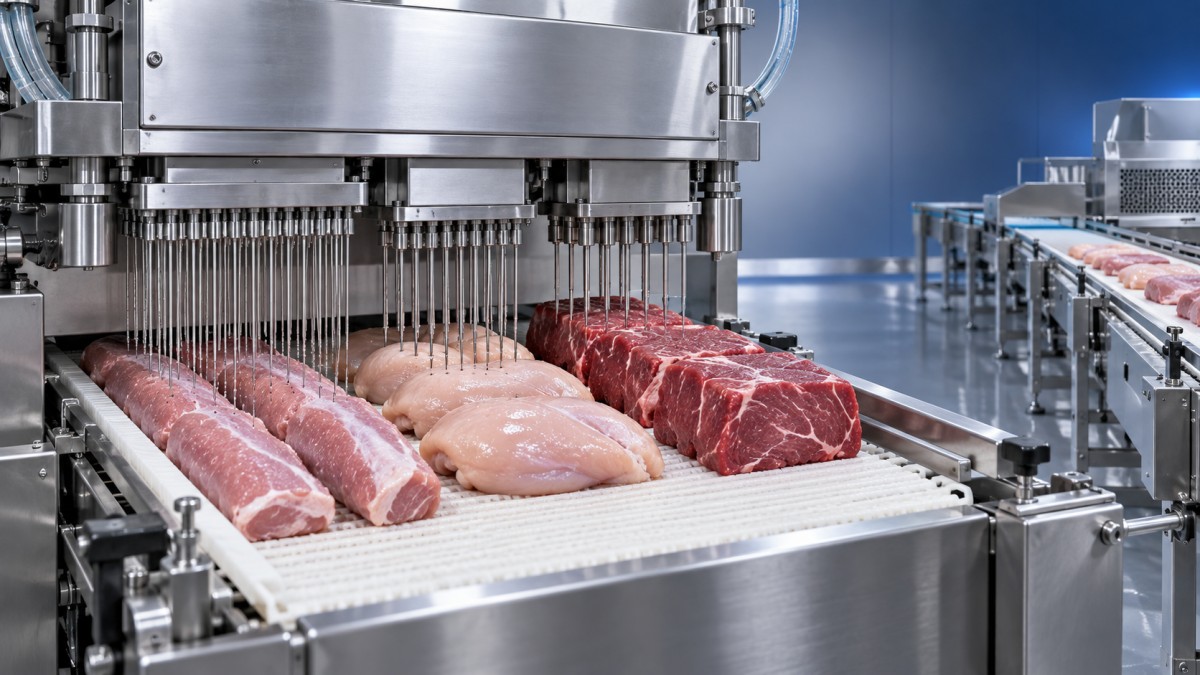
Fine filtration is especially important for poultry brines containing functional ingredients or seasoning particles. Needle blockages do not affect all needles equally. A partly blocked head can create a hidden pattern of under-injected areas that may not be obvious until after cooking or portioning. Technical evaluation should include how quickly filters can be inspected, how the system signals pressure changes, and whether the needle set can be removed without lengthy disassembly.
Beef: prioritize depth, strength, and tolerance for irregular muscles
Beef often presents the opposite challenge. Muscles can be thicker, firmer, and less uniform than poultry or many pork cuts. A very dense needle field may not provide the most efficient result if it lacks sufficient penetration capability or if needles encounter connective tissue. In many beef applications, a lower or moderate density arrangement with robust needles and controlled delivery provides better access to the interior of the muscle.
Large whole-muscle beef cuts require attention to needle length, needle diameter, injection pressure, and the ability to adjust the head to product thickness. Density should be sufficient to avoid broad untreated areas, but overly close spacing can increase tissue disruption without improving distribution. The practical target is a repeatable internal pattern that downstream tumbling or resting can equalize.
Bone-in beef requires additional caution. Needle layouts should be evaluated for how they handle bone contact, product positioning, and needle protection. A system that is suitable for boneless muscle may experience frequent bending or breakage if used on products with inconsistent bone geometry. The right response is not automatically a lower density; it may be a different product presentation method, a more suitable needle design, or a separate processing route.
Do not evaluate density without injection volume per needle
Two machines can have similar needle counts but behave very differently. The delivered volume per needle, injection frequency, pump response, and manifold balance determine how much brine reaches each point. A dense head running excessive volume can still create localized flooding. A lower-density head with carefully managed volume may produce acceptable distribution on thicker cuts.
Request an evaluation based on the intended product thickness and target pickup rather than a generic capacity claim. The equipment review should clarify whether adjustment is made through pressure, pump speed, belt speed, stroke timing, injection zones, or a combination of these controls. Each adjustment changes the process differently. Increasing pressure may improve penetration but also increase mechanical damage. Reducing belt speed raises exposure time but may reduce line capacity.
A practical trial sequence
- Run a representative product size range, including thinner and thicker pieces.
- Measure pickup immediately after injection and after the normal resting or tumbling stage.
- Cut samples through the thickest muscle areas to inspect distribution rather than judging surface appearance alone.
- Check for leakage, needle marks, missed zones, and variation between product edges and centers.
- Repeat after changing one control at a time: density configuration, pressure, belt speed, or delivery volume.
This sequence makes it easier to identify whether poor performance comes from the needle arrangement or from another process variable. Changing several settings at once often produces a result that cannot be interpreted reliably.
Sanitation and maintenance can change the preferred configuration
A denser injection head has more product-contact points and potentially more locations where seasoning particles or protein residue can accumulate. That does not make dense configurations unsuitable; it means cleaning access must be part of the decision. Food-contact surfaces made from 304 stainless steel support durable, hygienic construction, but material selection does not remove the need for practical access to needles, manifolds, filters, seals, and the brine circuit.
Assess whether operators can inspect needle straightness, replace damaged needles, and verify cleaning results without removing unrelated assemblies. The same engineering preference applies across processing lines. For example, equipment such as a Noodle-making machine may use food-grade 304 stainless steel for hygiene and durability, but each machine still needs a cleaning method suited to its own product-contact geometry. With injectors, needle bridges and brine paths deserve particular attention.
Select the needle density that gives the required internal coverage at the lowest practical level of tissue damage and operational complexity. For poultry, this often means a close pattern with restrained delivery. For pork, it commonly means flexible density and settings that accommodate several cut types. For beef, penetration capability and thickness tolerance frequently carry more weight than maximum needle count. The best Saline Injection Machine configuration is the one that maintains those results across normal product variation while remaining cleanable and serviceable between runs.
Product Center
Leave a message online