
NEWS
What Sanitation Features Matter in a Saline Injection Machine Changeover?
A sanitation-focused Saline Injection Machine should make changeovers predictable, inspectable, and fast enough to protect production time without compromising hygiene. For quality and food safety teams, the priority is not simply whether the machine can be washed. It is whether operators can fully remove product residues, brine deposits, and allergen carryover from every food-contact area without hidden zones or difficult manual work.
When comparing machines, look beyond the external stainless-steel frame. The strongest sanitation design is usually visible in the injection head, needle system, brine tank, filter housing, pump circuit, piping, seals, and drainage points. If these parts cannot be reached, opened, flushed, and visually checked during a normal changeover, a short cleaning schedule on paper will not reliably produce a clean machine in practice.
Start with the product-change risk, not the cleaning claim
A machine moving between similar, non-allergen meat recipes may need a different changeover standard than one switching from a seasoned poultry product to an allergen-containing marinade, or from cured meat to a fresh product line. Salt, proteins, spices, phosphates, sugars, starches, and particulate ingredients do not leave the same residue. A design that performs adequately with a clear brine can become difficult to clean when the formula contains seasoning particles or viscous ingredients.
Ask suppliers to explain how the exact brine recipe will travel through the machine and where it can remain after production stops. The answer should cover the route from the tank through filters, pumps, hoses, manifolds, needles, and return lines. “Easy to clean” is too vague unless the supplier can show which components are opened, which are flushed, and how the operator verifies that the circuit is empty and clean.
Features that materially improve changeover sanitation
Tool-free access to product-contact parts
Needle blocks, filters, pipe sections, strainers, and covers should be removable or openable without a long sequence of tools. This is not only a convenience feature. When access requires special tools, multiple fasteners, or an extended shutdown, operators are more likely to limit disassembly to the most visible areas.
Tool-free does not mean loose or fragile. The design should still use secure, repeatable fittings that can be assembled correctly after cleaning. During evaluation, ask for a live demonstration of removal and reassembly. Check whether parts can be handled safely while wet and whether small seals, clips, or gaskets can be misplaced.
Accessible needles and injection manifolds
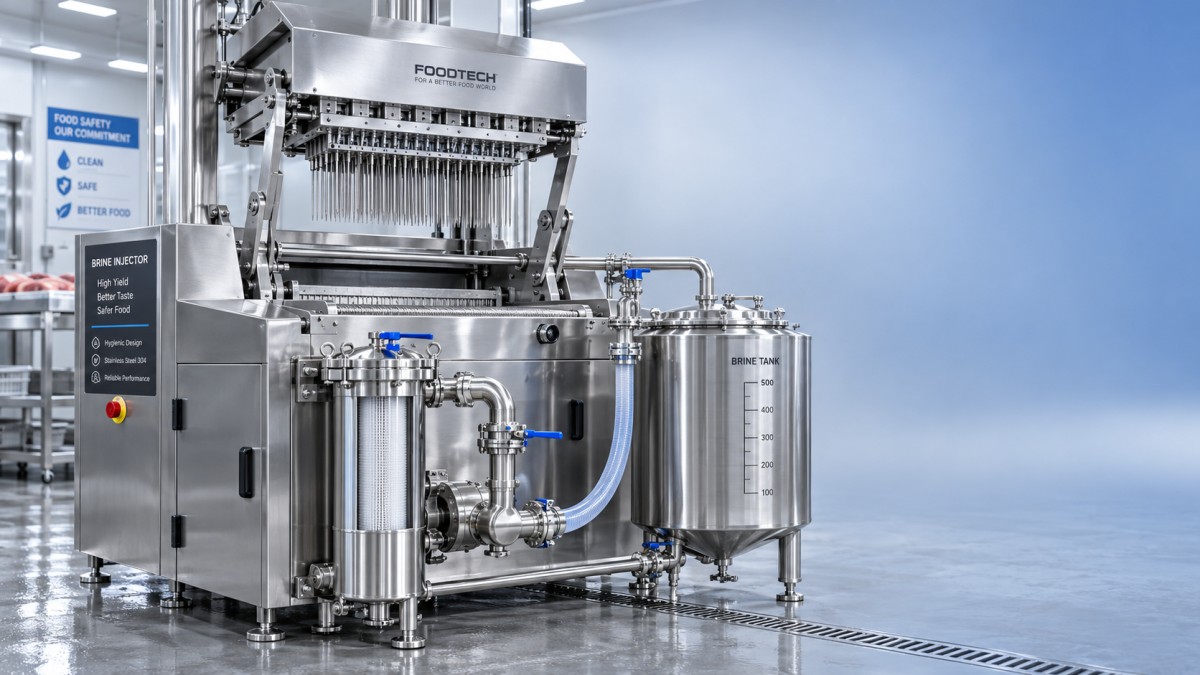
The needle area is often the most important sanitation point in a saline injector. Needles contact product directly, and their internal passages can retain residues if flushing is weak or blocked. A sanitary design allows the needle assembly to be raised, exposed, removed, or otherwise accessed for inspection. Operators should be able to see the underside of the injection head, the needle connections, and the area where brine enters the manifold.
Do not accept a design merely because it has an automatic needle-cleaning cycle. Automated rinsing is useful, but it does not replace visual access. Needles can clog, bend, or retain residue near connections. Machines with hard-to-reach needle blocks create a verification problem: the team may complete a cleaning cycle without being able to confirm that critical surfaces are actually clean.
Smooth, drainable food-contact surfaces
Food-contact surfaces should be smooth, corrosion-resistant, and free from unnecessary seams, sharp internal corners, thread exposure, or damaged welds. 304 stainless steel is widely used in food equipment because it provides a durable, cleanable surface when properly fabricated and maintained. Material selection matters, but workmanship matters just as much. Poorly finished welds and narrow crevices can defeat the benefit of stainless construction.
Drainability deserves equal attention. After a wash or rinse, liquid should move toward defined drains rather than sit in pipe low points, tank corners, pump housings, or flat trays. Standing water can dilute the next batch’s brine, retain cleaning chemicals, or create an avoidable hygiene concern. Inspect the machine both during operation and after draining, because a system can appear hygienic while still trapping liquid internally.
A brine circuit designed for full cleaning
The brine circulation system is where procurement decisions often have the greatest long-term impact. A removable tank alone is not enough. The pump, filter, return line, valves, hose connections, and injection manifold must be considered as one cleanability system.
Prefer a layout with short, direct product paths and few unnecessary branches. Dead legs, oversized cavities, and permanently fixed hoses make it harder to remove brine and inspect the circuit. Transparent or easily opened filter housings can help operators identify retained particles. Quick-release connections are useful where they expose the mating surfaces for cleaning rather than simply making a hose faster to disconnect.
For plants using more than one brine formula, ask whether separate dedicated components are practical for high-risk recipes. Dedicated needle sets, filters, or hose assemblies can reduce changeover complexity when a complete strip-down would otherwise be required. This approach is most useful when product scheduling cannot reliably separate incompatible formulations.
What to inspect during a supplier demonstration
Purchase discussions should include a sanitation demonstration, not just an operating demonstration. A machine that injects evenly in a clean showroom may still be labor-intensive to change over on the production floor. Request a walkthrough that follows a realistic sequence: stop, drain, disassemble, wash, rinse, inspect, reassemble, and prepare for the next batch.
Do not confuse washdown resistance with hygienic design
A saline injector may tolerate external washdown yet still be difficult to sanitize internally. Splash-resistant electrical enclosures, sealed motors, and robust construction are valuable for protecting equipment, but they do not prove that the food path is cleanable. Evaluate external washdown protection separately from product-zone hygiene.
The same distinction applies to automation. Automatic cleaning functions can reduce labor and improve consistency when they deliver adequate flow through all relevant paths. However, an automated cycle cannot compensate for inaccessible components, poor drainage, or trapped product pockets. The better question is: after the cycle, what must still be opened and inspected?
Build the changeover into the buying decision
Before selecting a Saline Injection Machine, create a short changeover map based on your own products. List the recipes, allergen risks, particulate levels, product temperatures, expected batch sequence, and required production restart time. Then use that map to evaluate machine designs. A plant running one stable brine formulation can prioritize efficient routine cleaning. A plant with frequent recipe changes should place more weight on accessibility, fast disassembly, component identification, and clear reassembly controls.
Also consider the sanitation of upstream and adjacent equipment. Brine preparation, holding tanks, transfer pumps, and connections can reintroduce residues after the injector has been cleaned. In facilities that process both meat and dough-based products, hygiene reviews should cover shared utilities, traffic patterns, and cleaning tools across the broader equipment layout. For pasta applications, a vacuum Dough Mixer is designed for flour-and-water mixing, which is a separate process from meat injection; it should be evaluated under its own cleaning and allergen-control plan rather than treated as interchangeable equipment.
The most practical purchasing standard is simple: a trained operator should be able to clean, inspect, and reassemble the injector correctly every time without relying on memory, excessive tools, or inaccessible internal areas. When the machine design supports that standard, sanitation becomes a controlled part of changeover instead of a recurring source of production risk.
Product Center
Leave a message online