
NEWS
Building a High-Throughput Ham Line Around a Saline Injection Machine
Building a High-Throughput Ham Line Around a Saline Injection Machine
When a ham line begins to miss its yield targets, the injection stage is often blamed first. Sometimes that is justified. More often, however, the issue sits at the interfaces around it: uneven raw-material presentation, unstable brine temperature, insufficient dwell time before tumbling, or a downstream process that cannot absorb the injector’s real output.
For a technical evaluator, building a high-throughput line around a Saline Injection Machine is not simply a matter of selecting the fastest available model. The practical objective is to create a controlled flow from incoming pork cuts to packed product, where brine pickup, distribution, texture, hygiene, and line speed remain repeatable across shifts. That calls for coordinated equipment sizing, sensible buffer design, and a sanitation plan that works in the real production day—not only on a layout drawing.
Start with the product specification, not the nameplate capacity
“Ham” can mean a wide range of products: whole-muscle cooked ham, formed ham, smoked joints, sliced deli portions, or injection-treated raw material for a further cooked product. Each creates a different loading pattern for the injection system. Before specifying equipment, define the operating window in measurable terms:
- Cut type, average weight range, thickness, and natural shape variation
- Target injection percentage and acceptable pickup tolerance
- Brine formulation, including salt, phosphates, proteins, starches, flavorings, and particulates
- Required daily throughput, actual production hours, and planned sanitation time
- Post-injection resting, tumbling, molding, cooking, chilling, and packaging requirements
A line designed only around theoretical kilograms per hour can become difficult to operate. For example, a machine may have adequate pumping capacity but still underperform if operators must slow the conveyor to accommodate thick or irregular cuts. Likewise, a high injection rate can appear successful at the scale while producing uneven internal distribution that becomes visible after cooking and slicing.
The best capacity calculation therefore includes a realistic efficiency allowance for loading, product changeovers, brine replenishment, needle cleaning, and normal variation in incoming meat. A stable line at a sustainable rate is usually more valuable than an aggressively sized system that repeatedly creates bottlenecks downstream.
The injection zone is a system, not an isolated machine
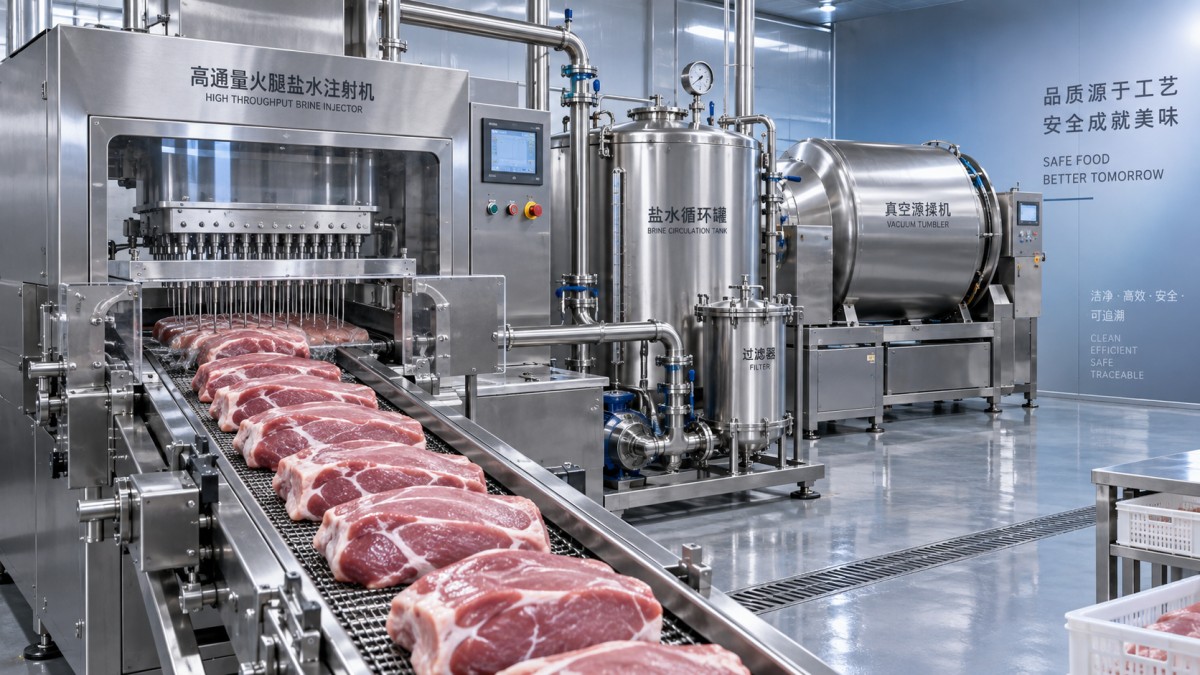
A Saline Injection Machine should be positioned within a short, controlled sequence. Product arriving at the needles should be evenly spaced, correctly oriented where necessary, and free from excess surface debris that could affect needle entry or sanitation. A suitable infeed conveyor and a modest accumulation section help prevent the injector from cycling between starvation and overload.
Inside the injection zone, several variables work together:
- Needle configuration: Needle diameter, hole pattern, number of needle heads, and injection pressure should match the structure of the cut and the viscosity of the brine.
- Conveyor control: Belt speed and stroke timing determine how injection points are distributed through the muscle.
- Brine circulation: Mixing, filtration, temperature control, and recirculation must keep the liquid homogeneous throughout the shift.
- Product support: Reliable belt or drum support reduces deformation and helps produce consistent penetration, especially with smaller or softer pieces.
Technical teams sometimes focus on pressure as the primary adjustment. Pressure matters, but it should not be used to compensate for poor needle selection, unstable brine, or inappropriate conveyor speed. Excessive pressure may create local pockets, surface leakage, or texture damage. A balanced setting is one that achieves the intended pickup while preserving the recognizable muscle structure that consumers expect from ham.
Design the brine room as part of line performance
Brine preparation is frequently treated as a utility task placed somewhere beside the processing room. In a high-throughput ham operation, it deserves more attention. The injection machine can only deliver a consistent result when the brine remains properly dispersed, filtered, and held at the appropriate process temperature.
Consider separate areas or clearly controlled steps for water dosing, dry-ingredient addition, mixing, filtration, chilled holding, and transfer to the injector. Ingredients that are poorly hydrated or not fully dissolved can settle, obstruct fine filtration, and contribute to inconsistent injection. The problem may initially look like a needle issue even though it began in brine preparation.
Brine tanks, pipelines, pumps, and contact surfaces should be selected for food processing conditions and routine cleaning. Food-grade 304 stainless steel is a practical baseline for equipment frames, tanks, and product-contact areas because it combines corrosion resistance with a smooth, cleanable finish. Material selection alone does not create hygienic design, though. Avoid inaccessible corners, poorly drained pipe runs, and unnecessary threaded connections in wet areas. The line should be laid out so operators can see spills, access guards, and complete cleaning tasks without improvisation.
What must happen immediately after injection
Injection adds brine; it does not complete the curing process. The product needs time and mechanical handling appropriate to the recipe for distribution and protein extraction. Depending on the ham format, this may mean a resting conveyor, chilled holding, vacuum tumbling, or a combination of these stages.
The connection between the injector and tumbler is especially important. If the tumbler is too small, injection must pause while batches are processed. If it is oversized without enough upstream supply, it operates inefficiently and creates awkward waiting periods. A buffer conveyor or chilled staging area can smooth the transition, but the buffer should be sized to protect product temperature and traceability, not merely to hide a mismatch in capacities.
For lines that also prepare formed or comminuted meat components, a Meat mixer can support consistent seasoning and additive distribution before the material enters its next forming or processing stage. Models with double-shaft fan-shaped propellers, forward and reverse rotation, temperature display, recipe storage, and automatic discharge are useful where repeatability across multiple formulations matters. The correct mixer volume should be matched to batch rhythm rather than selected only by the largest available capacity; a mixer waiting for product or forcing partial batches can disrupt the entire schedule.
Balance throughput from receiving to packaging
A high-output injector does not make a high-output ham line unless every subsequent process can keep pace. Evaluate capacity as a chain:
In many facilities, cooking and chilling—not injection—set the true daily ceiling. That does not reduce the importance of the injector. It means the injector should be selected and operated to match the line’s constraint, with enough flexibility to support future expansion without overwhelming the current process.
Automation should improve control, not add complexity
Automation compatibility is valuable when it gives production teams usable control over recipes, traceability, and deviations. A well-integrated line may link conveyor speeds, brine pump operation, product counting, batch identification, and alarms for low liquid level or abnormal pressure. Recipe-based settings can reduce dependence on individual operator memory when the plant runs several ham formats.
Still, the interface should remain understandable on the floor. Operators need clear access to daily parameters: actual pickup, brine temperature, filter condition, needle status, conveyor speed, and sanitation confirmation. Maintenance personnel need space to inspect pumps, seals, belts, and electrical components without dismantling half the line. An automated system that is difficult to clean or troubleshoot can quickly lose its value during a busy production week.
Commissioning: prove consistency before chasing maximum speed
Commissioning should begin with representative product, not idealized samples. Run light, average, and heavy cuts; assess several points across the conveyor width; and check pickup before and after downstream tumbling. Cooking trials are equally important, since the final sliced appearance, purge level, bind, and texture reveal whether the injection profile is truly suitable.
Document a baseline for each recipe: needle arrangement, pressure range, belt speed, brine temperature, filtration practice, and expected post-process yield. This record gives technical teams a disciplined way to troubleshoot future variation. If performance changes, they can compare actual operating conditions with a known acceptable setup instead of adjusting multiple variables at once.
A well-built ham line feels calm even at high volume. Product advances without sudden stops, brine remains controlled, downstream equipment receives a predictable flow, and sanitation is designed into the process rather than squeezed in afterward. Centering that design on the right Saline Injection Machine creates more than throughput—it creates a process that technical teams can validate, maintain, and scale with confidence.
Product Center
Leave a message online