
NEWS
Which Sausage Clipper Format Fits High-Speed Portioning and Casing Sizes?
High-speed sausage portioning is rarely limited by the nominal output of the filler alone. The clipping station must close each portion at the same pace, maintain closure integrity under product pressure, and accept the casing diameter and material used on the line. A clipper that is fast on a narrow collagen casing can become the bottleneck when moved to a larger fibrous casing, a high-viscosity emulsion, or a product requiring a long, clean separation between portions.
The most reliable selection rule is to begin with the finished sausage geometry and line sequence, not with the clipper’s stated cycles per minute. Casing caliber, stuffed diameter, product pressure, portion spacing, clip profile, and whether the line must form a hanging loop all affect the suitable format. “Sausage Clipper” is therefore not one equipment category with a simple capacity ranking; it is a group of closure systems built around different casing and throughput conditions.
Start with the closure requirement, not the casing label
Casing suppliers commonly describe casings by nominal caliber, but the clipper closes a compressed, filled casing tail rather than an empty tubular casing. The actual material bundle entering the closing tools depends on stuffing pressure, casing wall thickness, moisture condition, product particle size, and the amount of product displaced from the neck before clipping. This is why a casing diameter alone is insufficient for selecting clip size.
A technically valid evaluation should define the maximum and minimum compressed neck dimensions expected in production. It should also account for process variation: cold and warm product behavior, different meat formulations, casing batches, and start-up or end-of-batch pressure fluctuations. The clip must form tightly enough to resist internal pressure and handling loads without cutting the casing, cracking brittle material, or leaving an excessive tail that interferes with downstream handling.
Clip size is usually expressed through the clip’s flat width or related manufacturer-specific designation. It should not be treated as a direct conversion from stuffed sausage diameter. A larger casing may still present a manageable neck if it is gathered effectively, while a firm product in a smaller casing can create a dense neck that requires a different clip profile or closing force.
Where the main clipper formats differ
The practical distinction is less about whether a machine applies a metal clip and more about how it receives casing, creates the portion, applies one or two clips, cuts the separation, and feeds clips continuously.
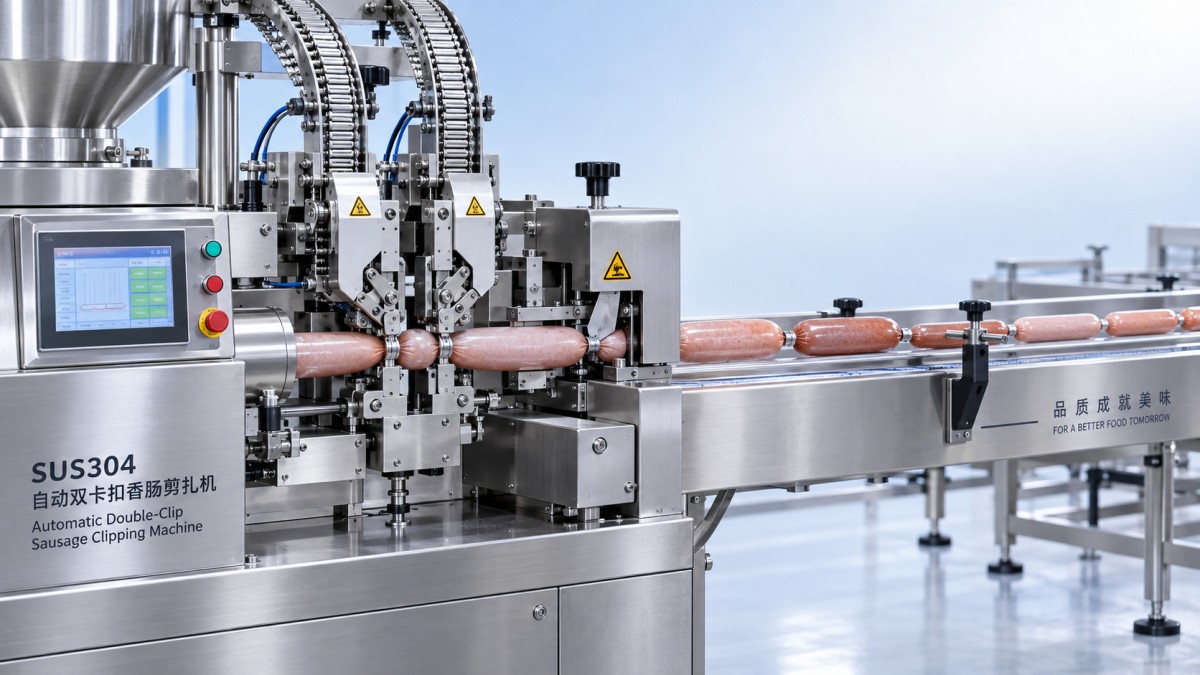
For high-speed linked or individually separated sausages, the automatic double-clip format is normally the relevant starting point because it places two closures around the separation point and cuts between them. This avoids relying on a single closure to define both adjacent products. However, a double-clipper only delivers stable high-speed output when the filler, portioner, casing brake, clip feed, and cutting sequence are matched as one system.
Single-clip configurations retain a role where one sealed end is sufficient, such as particular bagged, stuffed, or manually handled products. They should not be selected simply because their mechanical arrangement appears simpler. If the intended product needs discrete portions with sealed ends on both sides, converting a single-clip operation into a high-throughput portioning process can introduce handling steps that erase its apparent simplicity.
High speed is a synchronization problem
Cycle rate on a specification sheet is only meaningful when tied to actual portion length, filler behavior, and casing feed. A clipper may have a high mechanical cycling capability, yet the line can still lose output through delayed casing braking, inaccurate portion signal timing, incomplete product evacuation from the neck, or clip magazine changeovers.
For small-diameter sausages with short portions, the machine must repeat the gather–close–cut sequence in a compressed time window. The decisive questions are whether the clipper receives a stable portioning signal, whether the filler can stop or modulate flow predictably, and whether the casing is controlled during the brief transition between portions. A poorly coordinated system often shows irregular product lengths, variable necks, smeared cut faces, or occasional underfilled ends rather than a simple reduction in rated speed.
Larger-caliber products place a different demand on the mechanism. Their lower portion frequency may reduce the need for extreme cycling speed, but the gathered casing bundle is thicker and the clip must withstand greater internal loading. The closing tools, clip geometry, and pneumatic or servo-driven force must be assessed for the actual casing material. A format optimized for rapid narrow-casing work may not deliver a dependable closure on a large fibrous casing just because its nominal clip range overlaps.
Casing material changes the selection outcome
Natural, collagen, cellulose, fibrous, and plastic casings behave differently at the clipping point. Their friction, elasticity, thickness, and resistance to clip compression affect both closure quality and the risk of damage.
- Collagen casings generally require controlled gathering and closure force. Excessive compression can damage the casing or create inconsistent break behavior.
- Natural casings vary in wall thickness and elasticity, making neck formation less uniform. The clipper must tolerate this variability without frequent adjustment.
- Fibrous casings used for larger cooked or smoked products can require a stronger, appropriately sized closure and may be paired with loops for hanging.
- Plastic casings can be durable but may spring back after gathering. The selected clip profile and closing force must hold the compressed material securely.
Compatibility should be confirmed using the exact casing family and product formulation planned for operation. A supplier statement that a machine handles a broad diameter range is useful only if the associated clip series, gathering arrangement, and closing tools cover the relevant casing behavior. The evaluation should request the usable range for each clip type rather than relying on one overall machine range.
Clip feed format and downtime deserve equal attention
At high output, clip replenishment becomes a process issue, not a minor operator task. Clipper systems may use clip sticks, spooled clips, or manufacturer-specific cartridges and rails. The format affects reload frequency, accessibility, sanitation exposure, and the chance of feed interruptions. A high-speed line can lose substantial productive time if the selected clip supply requires frequent stops or has limited tolerance for misalignment.
The clip supply arrangement should be assessed together with the expected production run length and the availability of the selected clip series in the processor’s supply chain. Changing clip sizes between product families may also require changes to closing tools, gathering components, or machine settings. A broad nominal capacity range does not necessarily mean changeovers are quick enough for a line that regularly alternates between snack-size portions and larger smoked products.
Sanitary access matters here as well. Meat residue can accumulate around gathering belts, voiding areas, knives, clip channels, and discharge guides. Food-contact components should be suitable for washdown conditions, and the design should permit inspection and cleaning without turning routine sanitation into a lengthy disassembly exercise. Stainless-steel construction, including 304 stainless steel where appropriate for the equipment environment, supports durability but does not by itself establish hygienic performance. Drainage, open access, surface finish, seal design, and the absence of difficult-to-clean recesses are equally relevant.
Integration points that should be verified before purchase
A clipper should be evaluated as an interface between upstream stuffing and downstream handling. The required information exchange may include portion length, portion weight, clip timing, product count, fault status, and line stop signals. Where a vacuum filler or portioning system controls product flow, confirm who owns the synchronization logic and whether the interfaces are validated for the intended operating mode.
Also examine physical integration: product discharge height, casing routing, space for clip loading, access for cleaning, compressed-air quality and pressure requirements, electrical supply, and safe access to knives and moving gathering components. A compact machine can still be difficult to maintain if a wall, filler frame, or conveyor prevents access to the clip magazine or closing head.
This same integration discipline applies across mixed food-production facilities. For example, an Automatic dumpling machine has no role in sausage clipping, but its stated need for controlled air supply, tool-free cleaning access, and defined forming conditions illustrates why utility and hygiene reviews should be completed at line level rather than machine by machine.
A practical fit decision
Choose an automatic double-clipper when the production requirement is high-speed, individually separated portions and the filler can provide repeatable portion control. Select a loop-capable version only when the finished product genuinely requires hanging or suspension; adding loop capability without a downstream use increases complexity without improving closure performance. Use a large-caliber clipper when casing neck size, product pressure, and clip strength demand it, not merely because the product has a large visible diameter.
The strongest selection evidence is a representative trial using the intended casing, clip, formulation, portion weight, and target operating rhythm. The trial should inspect closure security, casing damage, portion-length variation, cut quality, clip feed reliability, and cleaning access after operation. That evidence is more decision-useful than a maximum-cycle claim, because it tests the exact point where high-speed portioning and casing compatibility either work together or fail.
Product Center
Leave a message online