
NEWS
Clip Material Compatibility for Sausage Clipper Lines and Food Safety
Clip material is a food-safety decision, not a minor consumable choice. On a sausage line, the clip is the final mechanical barrier at each end of the portion. If it does not match the casing, product formulation, cleaning regime, and clipping head, the result can be more than an occasional loose closure. It can create leakage, rework, foreign-material concerns, inconsistent shelf life, and traceability questions that place added pressure on quality-control teams.
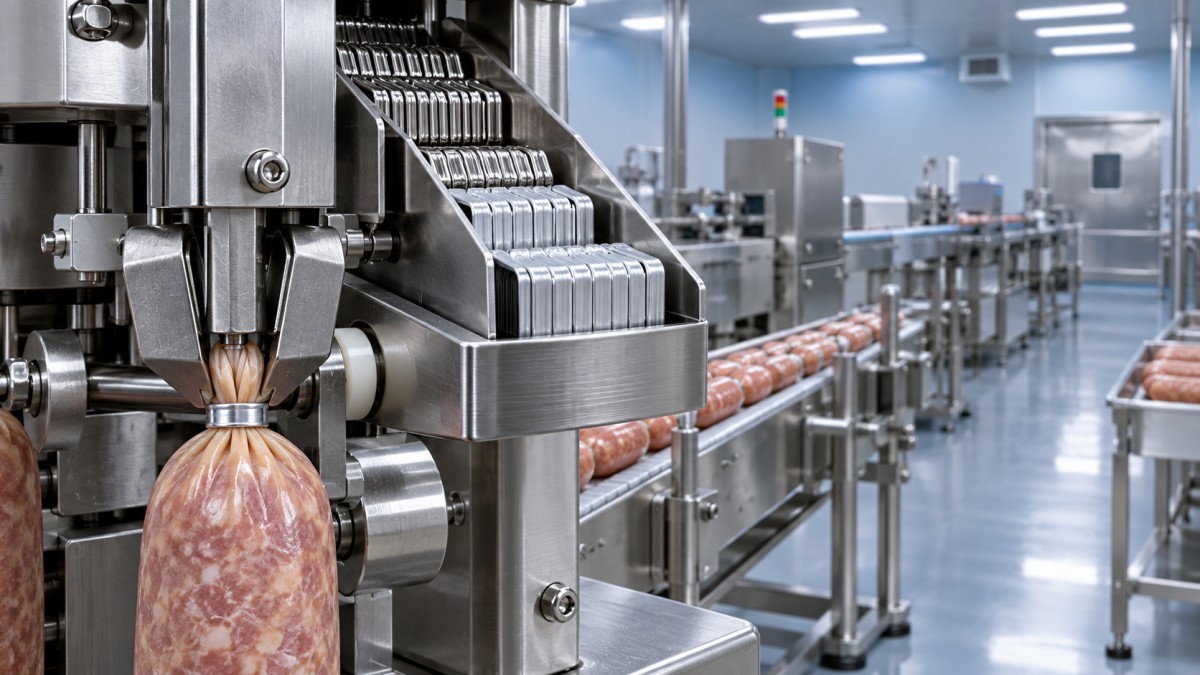
For most meat processors, the practical starting point is straightforward: select clips as a validated system with the casing and the Sausage Clipper, rather than specifying material from a catalogue in isolation. Aluminum, stainless steel, coated clips, and different clip profiles may all have valid uses, but their suitability depends on the line's operating conditions. A clip that performs well on a dry, low-acid cooked sausage line may be a poor choice for a moist product, an acidic recipe, or a process that involves aggressive sanitation chemicals.
What clip compatibility actually means
Compatibility is often reduced to whether a clip can physically fit through the clipping machine. That is only the first check. A clip must also close uniformly around the selected casing, retain its closure through cooking or chilling, and remain stable during downstream handling, transport, and opening by the customer.
The casing is central to this assessment. Natural, collagen, fibrous, plastic, and barrier casings do not respond to compression in the same way. Some casings need a more controlled closure force to avoid cutting or tearing; others need enough compression to prevent fat or moisture from working through the gathered end. Clip geometry, leg length, wire thickness, and closure shape all affect that outcome. The same nominal clip size can therefore behave differently when the casing wall, stuffing pressure, or product particle size changes.
Product formulation also has a role. High-fat emulsions, coarse-ground products, products with visible inclusions, and formulations containing salt, spices, smoke components, or acidic ingredients can place different stresses on the closure area. A clip that holds a smooth emulsion may struggle where larger particles prevent a clean casing gather. Quality teams should review closure performance under normal production variation, not only during an initial run with ideal product consistency.
The equipment supplier should be able to identify the approved clip range for each clipping head. However, an approved mechanical range does not automatically establish food-safety suitability for every application. The site still needs to assess material documentation, corrosion behavior, cleaning exposure, and whether the selected clip can be properly controlled within its food-contact risk assessment.
Material choice: focus on corrosion, integrity, and cleanability
Aluminum-based clips are widely used because they are light, formable, and suited to many sausage clipping applications. Their performance should still be assessed against product exposure and washdown conditions. Where clips may contact moisture, brine, residues, or certain cleaning agents, surface changes can occur if the material and process chemistry are poorly matched. Those changes may be cosmetic, but they can also signal conditions that deserve investigation.
Stainless steel clips can offer stronger resistance in demanding environments, but “stainless” is not a complete specification. The grade, surface condition, forming behavior, and compatibility with the clipping head all matter. A harder or differently shaped clip can change closing force requirements and may accelerate wear if the machine is not set up for it. Specifying a corrosion-resistant clip without confirming tooling compatibility can trade one risk for another: better material resistance but irregular closure formation.
Coatings may be used to improve processing characteristics or surface protection. They should be evaluated as part of the food-contact system, including the effect of heat processing, chilling, product contact, and cleaning. A coating that flakes, abrades, or reacts adversely to sanitation chemicals is a quality concern even if the underlying metal remains intact.
A useful question for procurement is not simply, “Which clip is food grade?” It is: “Which clip material and finish remains intact and suitable across our full process?” That process should include stuffing, clipping, cooking where applicable, cooling, storage, handling, and any customer-facing opening step.
Food-safety risks are usually created by process variation
Clip-related risks are rarely limited to a dramatic clip failure. More often, they develop through variation that is easy to overlook: a worn punch, an incorrect die setting, a mixed batch of clips, changing casing dimensions, or cleaning chemicals that remain in contact with metal components longer than intended.
- Closure leakage: A weak or incomplete closure can allow product purge, microbial entry after processing, or loss of vacuum where vacuum packaging is used.
- Casing damage: Excessive compression, incorrect clip profile, or poor alignment can create tears at the gathered end. The defect may become visible only after thermal processing or chilled storage.
- Foreign-material exposure: Damaged clips, wire fragments, coating debris, or clips deformed during machine handling should be treated as a control concern. Detection capability and rejection procedures need to reflect the metal type used.
- Corrosion and residue retention: Corroded or roughened surfaces can complicate inspection and may retain residues. The source may be the clip material, the environment, the sanitation program, or interaction among all three.
- Traceability gaps: Clip lots can be overlooked because they are small, high-volume consumables. Without clear lot segregation and receiving checks, an investigation into closure defects becomes unnecessarily difficult.
These risks support a more disciplined validation approach. A line trial should include samples taken at different points in a production run, after start-up adjustments, and after planned cleaning cycles where practical. Inspection should look beyond whether the clip remains attached. Teams should examine closure symmetry, casing pinch damage, product leakage, clip deformation, and consistency across multiple machine heads.
Questions to put to clip and equipment suppliers
Purchasing teams can reduce uncertainty by requesting application-specific answers rather than generic material claims. The clip supplier should be able to identify the intended casing range, compatible clipping head or tooling arrangement, material composition, finish, and recommended storage conditions. Documentation should support the processor's own food-contact and supplier-approval procedures.
For the Sausage Clipper supplier, the important questions concern operating control: how clip feed is monitored, how incorrect clip presentation is detected, how worn closing components are identified, and which setup settings are controlled when casing or clip specification changes. The machine's hygienic design matters as well. Clip magazines, guides, and closing areas need to be accessible enough for cleaning and inspection, especially on lines with frequent product changeovers.
It is also sensible to ask how the clip type interacts with installed detection systems. Metal detection and X-ray performance are influenced by product size, packaging configuration, detector location, and metal type. The goal is not to assume that one method will identify every potential issue, but to confirm that the site has a documented response when a clip-related defect is suspected.
Do not separate clipping control from upstream product handling
Many closure problems originate before the product reaches the clipper. Inconsistent temperature, poor particle distribution, insufficient vacuum during filling, and variable stuffing pressure can all alter how the casing gathers at the end. This is particularly relevant when processors work with frozen raw material. A controlled preliminary cutting stage, such as a Frozen meat shredder designed to cut frozen blocks before grinding or mixing, can help maintain a more consistent raw-material flow when the process is built around frozen meat handling. The point is not that upstream equipment replaces clip validation; it helps prevent product inconsistency from being mistaken for a clip-material fault.
For quality and food-safety managers, the strongest specification links these steps together. It defines the casing, clip material and dimensions, approved clipping tooling, product family, filling parameters, cooking or chilling conditions, sanitation chemicals, inspection criteria, and lot-control method. A change to any one of those items should trigger a review of whether the original closure validation still applies.
A practical purchasing decision
Select the clip material only after identifying the product and process conditions it must survive. Start with the casing supplier's requirements and the clipping machine's approved tooling range. Then assess corrosion exposure, sanitation chemistry, thermal conditions, closure integrity, foreign-material controls, and documentation needs. Where multiple products run on one line, avoid assuming that one clip specification is automatically suitable for all of them.
The safest procurement outcome is usually a controlled, documented combination rather than the lowest-priced clip that fits the magazine. A clip is inexpensive compared with the sausage it closes, but a poorly matched closure can affect an entire batch's quality status. For food-safety teams, that is sufficient reason to treat clip compatibility as a line-control decision from the beginning.
Product Center
Leave a message online