
NEWS
Double Clipping Explained: Preventing Product Leakage at Sausage Ends
Double clipping seals a sausage end with two adjacent clips rather than one. The paired closure creates a wider mechanical barrier across the gathered casing and leaves less opportunity for emulsion, brine, fat, or trapped air to force a path through the end. It is especially valuable where filling pressure is high, the product is finely emulsified, the casing is slippery, or a small seal defect would become visible during cooking, cooling, transport, or retail handling.
A single clip can look acceptable immediately after closing and still fail later. The casing may slowly relax under load, the clip legs may not maintain enough compression, or a small channel may open where folds were trapped beneath the clip. Double clipping provides redundancy, but it does not compensate for poor casing preparation, unsuitable clip size, or incorrect machine setup. The two clips must work as a controlled closure system rather than two separate impacts on the same weak gather.
What Happens at the Sausage End
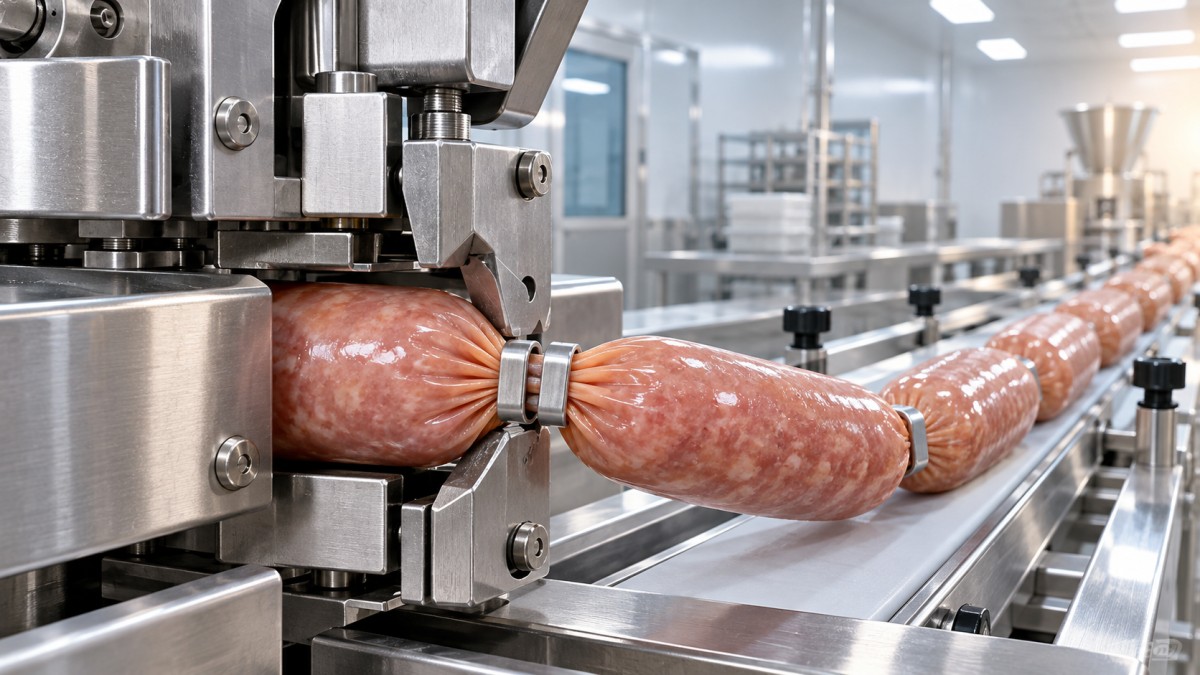
Before clipping, the casing is gathered into a compressed tail. The gathering action displaces product from the closing zone and forms layered casing material that the clip must compress. When a Sausage Clipper applies the first clip, the clip crown bends around that gathered material while its legs close and lock beneath it. A second clip is placed beside the first, usually with a defined spacing set by the machine's clip-feed and separation arrangement.
The first closure carries much of the immediate load. The second stabilizes the sealed section, reduces the effect of slight variation in casing thickness, and limits leakage if one edge of the first clip does not grip evenly. On linked products, the two clips also establish the cut zone between portions. This is why clip spacing matters: too little separation can distort the gathered casing or interfere with clean cutting; too much leaves an unnecessarily long neck that can flex, retain product residue, or reduce portion consistency.
Leakage Is Often a Closure-System Problem
End leakage is easy to attribute to insufficient clipping force, yet the visible defect alone does not identify the cause. Product escaping directly between the clip legs suggests incomplete compression, wrong clip profile, excessive casing material, or a worn forming punch. Leakage from the side of the clipped neck can indicate uneven gathering, casing wrinkles, or product remaining in the closure area. A split casing beside an intact clip points in a different direction: excessive stuffing pressure, casing damage, an unsuitable casing calibre, or a sharp edge in the discharge path may be responsible.
Timing also gives useful evidence. A leak observed at the clipper outlet is commonly linked to gathering and closure. A leak that appears only after thermal processing may result from expansion, protein setting, fat release, or pressure changes within the sausage. If failures appear after chilling, vacuum packing, or handling, flexing of an overly long neck, clip movement, or casing brittleness should be investigated. Treating all three conditions as “bad clips” often leads to adjustment of the wrong parameter.
Compression Must Match the Casing and Product
Clip selection is not simply a question of choosing the largest clip that will close around the casing. The clip must match the gathered diameter, casing type, wall thickness, and filling behavior. Fibrous, collagen, cellulose, and plastic casings respond differently to compression. A setting that produces a dependable seal on a dry, firm casing can cut or crease a softer casing. Conversely, a closure that appears gentle may be too loose once a high-moisture filling develops pressure.
The clip material and geometry should be suitable for the production environment and product format. Clip crown width, leg length, and closing profile influence how force is distributed through the casing folds. The clipper's die and punch must be compatible with that clip type. Mixing components that appear dimensionally similar can produce irregularly shaped closures, incomplete locking, or excessive deformation.
Filling consistency also changes the result. A coarse sausage mixture with defined particles behaves differently at the end from a smooth, pumpable emulsion. Large inclusions close to the casing tail can prevent a compact gather and create a leakage path. Thin batter may migrate quickly into the clipping zone when filling is not stopped or displaced at the correct moment. Product temperature matters because viscosity, fat firmness, and flow into the neck change as the mixture warms.
Conditions That Need Separate Evaluation
- High-pressure filling: A closure that passes a visual inspection may open when internal pressure rises. Confirm seal performance under the actual filling setting rather than using an empty-casing trial.
- Cooked or smoked sausages: Heat can alter internal pressure and casing tension. Inspect after the intended thermal cycle, not only before it.
- Large-diameter products: The gathered tail contains more material, so clip capacity and closing travel require attention. A correctly sized casing does not automatically create a correctly sized gathered end.
- Small linked portions: Separation accuracy becomes more sensitive because the two clips also define the neck and cutting position.
Reading the Shape of the Double Clip
A stable closure has two fully formed clips seated squarely across a compact casing gather. Their crowns should be consistently shaped, their legs should close without obvious gaps, and the clips should remain aligned with the product axis. The casing immediately around the closure should not show tearing, severe pinching, or product trapped at one side.
Alignment deserves attention because a clip can be fully closed yet poorly positioned. If the gathered casing enters the closing area off-center, one side receives more compressed material than the other. The result may be a seal that appears tight from above but has a narrow channel along the less-compressed edge. Repeated one-sided deformation is usually a machine-guidance or casing-feed issue, not random variation.
Clip overlap is another frequent misread. Excessive overlap may look secure because the clipped area is dense, but it can crush the casing fold and create damage adjacent to the closure. Wide spacing may leave a flexible section between clips that bends during linking, hanging, or packaging. The correct relationship is determined by the clip format, casing gather, and intended product handling, so it should be verified through trial runs under normal production conditions.
Machine Settings That Affect Seal Reliability
The closing stroke must reach the repeatable position required by the selected clip and tooling. Wear in punches, dies, guides, or clip rails can change the final closure shape gradually, making a problem difficult to notice until leakage increases. A machine may still cycle smoothly while producing clips with reduced holding force. Inspecting actual formed clips is therefore more informative than relying only on the absence of alarms.
Gathering pressure and displacement settings should remove product from the closure zone without damaging the casing. Too little displacement leaves filling material beneath the clips. Too much can thin the casing, stretch it excessively, or produce an elongated tail. The feed path should also keep casings centered and free from twist. A twisted casing can trap a folded section that resists uniform compression.
Where raw material is diced before sausage preparation, particle size and surface condition influence how readily the mixture clears the clipping area. Equipment such as a Fresh Meat Dicing Machine can produce cubes, strips, slices, or flakes for different downstream formulations; the relevant clipping concern is whether the final mix contains hard or oversized pieces that interfere with gathering. The dicing stage itself is not a sealing control, but it can create a downstream variation that becomes visible at the sausage end.
Verification Beyond a Quick Visual Look
A useful verification routine combines appearance with handling and process-stage observation. Examine both clips on samples taken across the run, including after reel changes, casing changes, cleaning, adjustment, and restart. Look for altered closure profile, asymmetric casing compression, inconsistent spacing, and filling residue around the neck. Compare samples from the beginning and later portions of a batch because component wear or product temperature drift may change the result.
Leak testing should reflect the product's real stress conditions. A gentle manual pull may reveal a gross closure defect but will not reproduce thermal expansion or pressure from a filled casing. Where a process includes cooking or cooling, retain samples through those stages and inspect the ends before and after handling. Record the casing type, clip format, tooling condition, filling setting, and observed defect pattern together. A leakage record without these links is difficult to turn into a corrective action.
Double clipping works best when the casing gather is clean, the clip is correctly formed, and the machine repeats the same closing condition throughout the run. The second clip adds protection, but dependable sausage-end sealing still comes from controlling the whole short section where product flow, casing material, clip geometry, and closing force meet.
Product Center
Leave a message online