
NEWS
Sausage Clipper Operating Costs: Clips, Casings, Maintenance, and Waste
The purchase price of a sausage clipper is easy to compare. Its operating cost is harder, because it is spread across every portion produced: clips, casings, setup time, maintenance labor, rejected units, and product lost during stoppages. For a processor evaluating a new line, the lowest-priced machine can become the more expensive option if it consumes proprietary clips, handles only a narrow range of casings, or creates frequent interruptions at the stuffing and clipping stage.
A useful evaluation starts with cost per finished, saleable sausage rather than cost per machine hour. That shifts attention toward the items that recur every day and exposes whether a clipper will remain economical when production volumes, recipes, or package formats change.
Clip consumption is a recurring production cost
Clips look inexpensive when considered individually, but their cost accumulates quickly because each product unit requires one or more closures. Twin-clipped portions, hanging loops, specialty formats, and production losses all increase consumption. The relevant question is not simply whether the clipper uses standard clips, but which clip series it requires, how reliably those clips are available, and whether the available sizes fit the plant's planned casing range.
Business evaluators should ask suppliers to define the compatible clip dimensions, material grades, magazine capacity, and feed configuration. A machine designed around a limited clip format may work well for a stable, high-volume product, yet become restrictive when a processor introduces new diameters or changes portion weights.
Clip-feed reliability also has a direct cost effect. A misfed clip can stop the line, create unsealed product, and force an operator to inspect or rework adjacent portions. The financial impact includes more than the lost clip. It can include filling loss, casing loss, labor, cleaning, and lost throughput while the machine is reset.
- Calculate clip use per sellable unit, including expected rejects and rework.
- Confirm whether clip supply is available locally or requires long lead times.
- Check if clips can be sourced from more than one qualified supplier without compromising machine performance.
- Review how quickly an operator can reload clips and recover from a feed interruption.
Casing compatibility often determines whether cost stays controlled
A sausage clipper does not operate independently from the casing. Natural, collagen, cellulose, fibrous, and plastic casings behave differently under pressure, tension, and compression. A clip setting that seals one casing reliably may damage another, create leaks, or leave an inconsistent closure. For this reason, stated clipping capacity should be treated as a starting point rather than proof that the machine is suitable for every planned product.
The most costly mismatch is often subtle. A clipper may close the casing successfully during a short demonstration, yet cause casing breakage after sustained runs, during changes in filling temperature, or when a recipe produces higher friction in the stuffing system. Small variations in emulsion texture, particle size, moisture retention, and stuffing pressure can alter the load applied at the closure point.
Before purchase, processors should test the actual casing types and product formulations intended for commercial use. Testing should include normal startup, continuous operation, end-of-batch conditions, and changeovers between sizes. It should also examine the closure appearance, leakage resistance, spacing consistency, and the amount of casing tail left after clipping. Excess tail is a modest material loss on one unit but can become meaningful across large production volumes.
Where products use a broad mix of casings, flexible adjustment is valuable only if settings can be changed accurately and repeated by different operators. A machine with many adjustment points can add risk if the correct setup depends on individual experience rather than documented parameters.
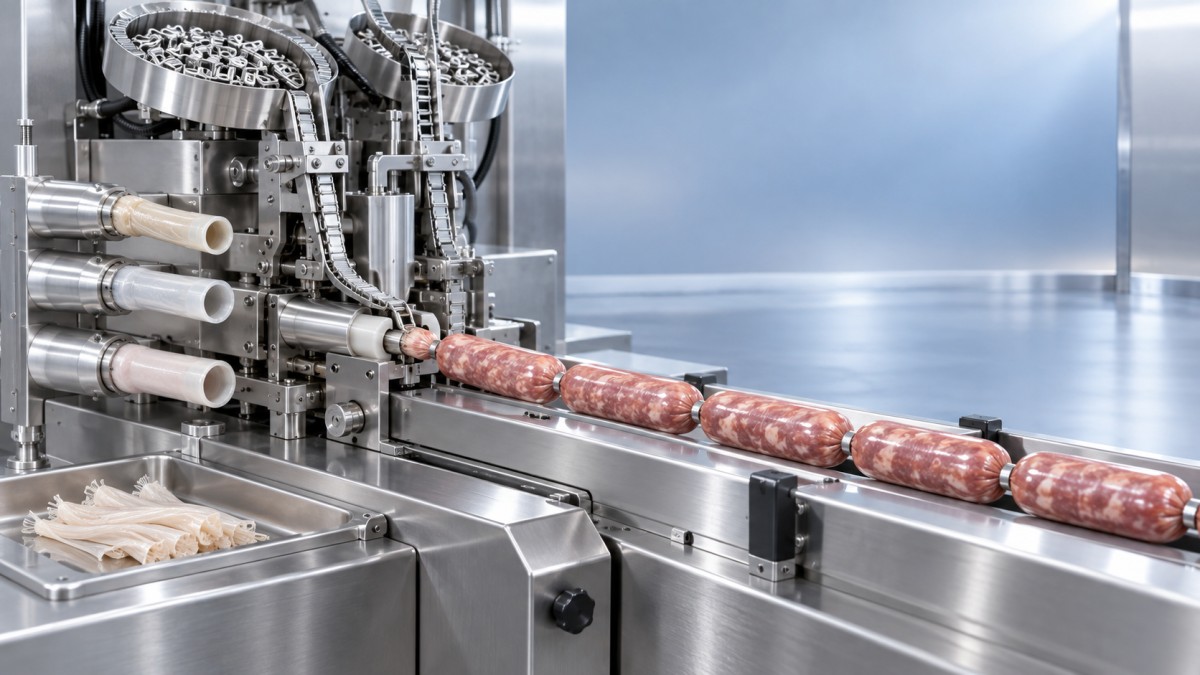
Waste is usually the largest hidden variable
Clip and casing costs are visible on purchasing records. Product waste is less visible because it may be recorded across several departments: meat preparation, filling, quality control, sanitation, and packaging. Yet it is often the most important operating-cost category when a clipping system is poorly matched to the process.
Waste can arise from burst casings, loose seals, irregular portion lengths, air pockets near the closure, product expelled during adjustments, or batches held while a machine fault is resolved. The lost value is based on prepared filling, not raw trim. By the time meat has been ground, mixed, seasoned, chilled, and transferred to the filler, it carries substantially more process value than the casing or clip that failed.
Air management upstream deserves attention in this calculation. Filling with excess entrapped air can contribute to inconsistent density, poor portion control, and pressure variation at the clipper. A vacuum mixing stage can help create a more compact, uniform filling and support more stable downstream handling. For plants reviewing the entire preparation-to-clipping flow, a Vacunum Meat Mixer can be relevant where vacuum mixing, low temperature rise, and adjustable forward/reverse mixing are needed before filling. The point is operational consistency: a clipper cannot fully compensate for filling whose texture, air content, or temperature changes significantly from batch to batch.
Waste should therefore be evaluated as a line-level issue. The procurement team should map where material is discarded or downgraded and distinguish normal startup loss from repeatable process loss. A lower-cost clipper that adds frequent small losses may be difficult to justify on products with high meat content, complex seasoning, or strict finished-weight requirements.
Maintenance cost is mainly about uptime and cleanability
Maintenance budgets often focus on replacement parts, but downtime is usually the more consequential expense. Wear components, cutting elements, clip guides, pneumatic seals, sensors, and drive components all need inspection and replacement at intervals that depend on product type, washdown practices, and operating hours. The practical procurement question is whether those items can be accessed, identified, and replaced without extended production disruption.
Ask for a preventive maintenance schedule that identifies daily checks, weekly cleaning points, lubrication requirements where applicable, expected wear parts, and recommended spare holdings. A supplier should also be able to explain fault indicators and the normal recovery procedure for common problems such as a clip jam, incomplete closure, casing break, or incorrect portion separation.
Construction material affects maintenance in less obvious ways. Food-grade 304 stainless steel is widely used in food-contact and washdown equipment because it supports hygiene-oriented design and resists routine processing conditions when properly maintained. Still, material specification alone does not guarantee easy sanitation. Open access to product-contact areas, detachable components, smooth surfaces, and the absence of difficult cleaning zones matter more in daily operation than a stainless steel claim on its own.
Cleaning time belongs in the operating-cost model. If a clipper has awkward product paths or requires repeated disassembly to remove residue, the plant pays through labor, lost production availability, and greater sanitation risk. A design that allows controlled access can reduce this burden, especially for facilities running multiple recipes or short production campaigns.
Labor efficiency depends on changeovers, not only automation
Automatic clipping can reduce manual handling, but labor savings vary sharply by production pattern. A long run of one casing diameter and one portion format allows an operator to supervise a stable process. A facility producing multiple diameters, seasonal items, or private-label formats may spend a meaningful share of the shift loading clips, changing tubes, adjusting settings, cleaning, and verifying first-off samples.
For that reason, claimed output rates should be reviewed alongside changeover time and the skill required to achieve stable results. A high theoretical clipping speed has limited value if the filler cannot supply product consistently, operators must repeatedly intervene, or downstream linking and packaging cannot keep pace.
Build the comparison around the intended production mix
A Sausage Clipper should be evaluated against the plant's actual product mix, expected run lengths, casing supply arrangements, and upstream filling consistency. A dedicated configuration may offer strong economics for a narrow, predictable range of products. A more flexible system may cost more initially but reduce future expense where casing diameters, formulations, or portion formats are likely to vary.
The most useful supplier discussion is therefore based on a representative production sheet: casing type and diameter, filling characteristics, target portion weight, clips per unit, planned shifts, sanitation routine, and expected changeovers. With those conditions defined, operating cost becomes a practical comparison of consumables, labor, uptime, and yield rather than a vague estimate attached to the machine price.
Product Center
Leave a message online