
NEWS
Vacuum Sausage Fillers: How They Improve Texture, Color, and Portion Control
A vacuum Sausage Filler improves product consistency when air management, emulsion condition, casing selection, and downstream handling are treated as one process. Its most visible benefits are a denser bite, cleaner cut surfaces, more stable internal color, and closer weight control. Those benefits are real, but they do not come from vacuum alone. A poorly prepared batter, an unstable filling temperature, or an incorrectly matched clipper can still produce soft texture, purge, uneven links, and weight variation.
For a technical evaluator, the practical question is whether vacuum filling removes a meaningful source of variation in the existing line. In most cooked, smoked, emulsified, or finely comminuted sausage applications, it often does. In coarse-ground products, the effect can be more dependent on recipe structure and how aggressively the product is handled before it reaches the filling hopper.
Why trapped air changes more than appearance
Air enters sausage batter at several points: grinding, mixing, transfer, loading, and filling. Once incorporated, it can remain as dispersed bubbles or collect as larger voids. Both conditions affect the finished product, although not always in the same way.
Large visible air pockets are the easiest defect to identify. They can leave holes on the cut face, interrupt the product's visual uniformity, and create local weak points under cooking or smoking. Smaller entrained bubbles may be less obvious before processing, yet they can still influence stuffing density, portion weight, and oxidation exposure.
A vacuum filling system draws air from the product path while conveying batter into the casing. With less air in the filled portion, the casing is more uniformly supported and the sausage body tends to hold a more consistent cylindrical form. This helps reduce the difference between a link that looks correctly filled at the horn and one that appears loose or irregular after thermal processing.
The result should not be interpreted as “vacuum always creates a firmer sausage.” Texture is primarily built by the meat protein system, fat distribution, particle size, salt and phosphate use where applicable, mixing intensity, and temperature control. Vacuum filling supports that structure by reducing voids and improving packing density. It cannot repair an emulsion that has already broken, nor can it compensate for a coarse formulation with insufficient bind.
For evaluation purposes, cut-face inspection remains useful. Compare products filled under vacuum and without vacuum using the same formulation, casing, temperature profile, and cooking conditions. Look beyond obvious holes. Assess cross-sectional density, fat smearing, surface smoothness, post-cook shrinkage, and the consistency of individual units across a production run.
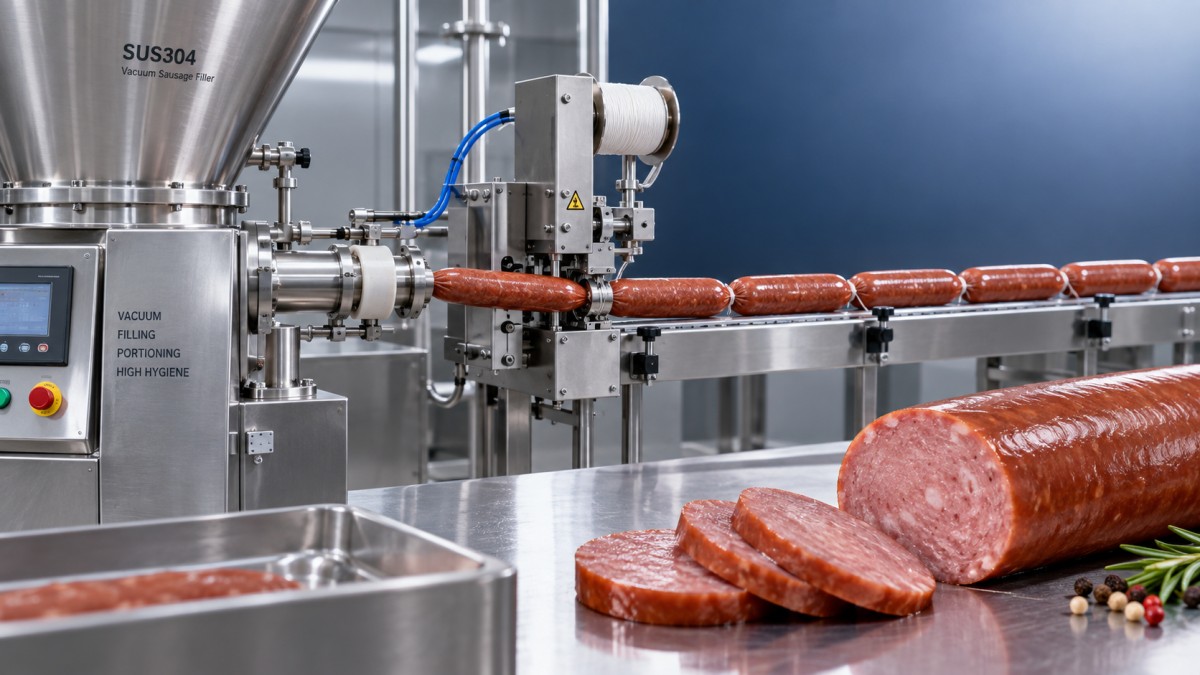
Texture: density helps, but process temperature decides the limit
A well-adjusted vacuum Sausage Filler can produce a tighter, more uniform fill because the batter reaches the casing with fewer trapped air pockets. That is particularly valuable for products where a smooth slice, clean bite, or homogeneous appearance is expected, such as frankfurters, cooked ham sausages, and fine emulsified products.
However, filling under strong vacuum can expose weaknesses upstream. If the batter is too warm, fat may smear during the pumping and filling stages. If it is overly cold or too stiff, flow can become unstable, causing pressure fluctuation and inconsistent casing tension. The machine setting must therefore be evaluated alongside the batter's actual process temperature and viscosity, not only against a nominal recipe.
Product flow should also be considered at the end of the filling horn. Excessive pressure, unsuitable horn geometry, or a casing that does not match the product diameter can stretch the casing unevenly. The filled sausage may initially appear compact but later show wrinkles, deformation, or purge after cooking. A denser fill is useful only when the casing can accommodate it through the full thermal cycle.
Technical teams should review three linked conditions during trials:
- Whether the batter reaches the filler at a stable, validated temperature range for that formulation.
- Whether vacuum level and filling speed maintain continuous flow without overworking the product.
- Whether casing caliber, horn diameter, and target stuffing pressure produce repeatable casing tension.
These checks are more informative than judging performance by maximum filling speed. High throughput is valuable only when texture, shape, and yield remain within the product specification.
Color stability begins with oxygen control, but does not end there
Reduced air incorporation can improve the visual consistency of sausage color, especially on sliced surfaces. Oxygen exposure can contribute to color changes in meat pigments and can accelerate oxidative effects in fat-containing formulations. By lowering the amount of air carried into the casing, vacuum filling reduces one source of oxygen in the finished product.
That benefit is conditional. Meat quality, formulation, curing system, storage temperature, cooking, smoke application, packaging atmosphere, and display conditions all influence color. Vacuum filling should therefore be treated as one control point within a broader color-management process.
It is also important to distinguish internal product color from surface appearance. A more uniform internal cut face may result from fewer voids and more even density. Surface color after smoking or cooking is influenced by separate heat and humidity conditions. When a plant sees uneven external color, replacing or adjusting the filler alone may not address the cause.
A useful technical approach is to record the defect location. If variation appears mainly in the core and around air pockets, review batter preparation, hopper loading, vacuum performance, and filling pressure. If variation is concentrated on the exterior, investigate thermal processing, smoke distribution, casing permeability, and post-process cooling.
Portion control depends on the complete filling-and-clipping system
Vacuum filling supports portion control because a more consistent product density makes volumetric filling more repeatable. When air content changes from portion to portion, the same nominal volume can result in different actual weights and different final lengths. Removing much of that variability gives the quantitative filling system a more stable product to dose.
Still, a filler does not control final portion weight in isolation. Portion accuracy is affected by pump calibration, product density, filling pressure, casing stretch, link separation, clipping position, and product loss at startup, changeover, and shutdown. A line can have a precise filling signal while producing inconsistent finished units if clipping is late, loose, or poorly synchronized.
This is where downstream equipment selection becomes directly relevant. A Sausage Clipper that links with a quantitative filling machine can help preserve the portion created at the filler by applying repeatable closure and separating the casing consistently. For products requiring automatic clipping and casing cutting, the clipping cycle must match the filler output without pulling product from the casing or leaving excess material between portions.
Adjustable clipping speed is useful when one line produces different diameters, casing types, or product lengths, but the adjustment range alone is not the selection criterion. Evaluators should confirm whether the clipper's operating speed, casing expansion range, center height, and pneumatic pressure match the intended filler, horn arrangement, and product format. A mismatch often appears as irregular tails, loose clips, casing damage, or unnecessary product giveaway.
What to evaluate before specifying equipment
A vacuum filler should be assessed against the product family, not as a generic capacity purchase. Fine emulsions, coarse fresh sausages, viscous meat mixtures, and products with visible inclusions do not place the same demands on pumping, vacuum control, and product handling. A machine that performs well on a smooth frankfurter batter may require different settings or component choices for a coarse sausage with larger meat and fat particles.
Begin with the process window rather than the headline output rate. Define the target portion range, casing types and calibers, expected product temperature, daily changeovers, required cleaning access, and the downstream clipping or linking arrangement. Then test for the defects that matter to the finished product: voids, weight spread, casing damage, purge, cut-face appearance, and consistency after cooking or chilling.
Hygienic construction also belongs in the technical evaluation. Food-contact surfaces should be designed for complete cleaning and inspection, with product areas that do not create difficult-to-access residue traps. Durable 304 stainless-steel construction is commonly valued for corrosion resistance and cleanability, but material grade alone does not establish hygienic performance. Weld finish, seal design, disassembly time, drainage, and access to the vacuum and product-contact zones affect sanitation in daily operation.
The best application of vacuum filling is not simply faster stuffing. It is a more controlled relationship between batter condition, fill density, portioning, and closure. When those controls are validated together, the equipment can reduce avoidable variation in texture, appearance, and unit weight without forcing the product outside its intended processing window.
Product Center
Leave a message online