
NEWS
Piston or Vacuum Sausage Filler: Choosing for Your Product Formulation
A piston filler and a vacuum filler can both produce acceptable sausage, yet they do not impose the same conditions on the meat batter. The practical decision is less about nominal output than about how the formulation behaves under pressure, shear, and entrained air. A formulation that fills cleanly through a piston system may show air pockets, inconsistent density, or poor cut appearance when transferred to a vacuum process without adjustment. Conversely, a product designed around vacuum filling can lose some of its expected texture or portion uniformity when filled by a conventional piston machine.
The central question is therefore not which Sausage Filler is “better.” It is whether the filling principle matches the product’s viscosity, particle structure, emulsion stability, and downstream process requirements.
Two filling principles, different effects on the product
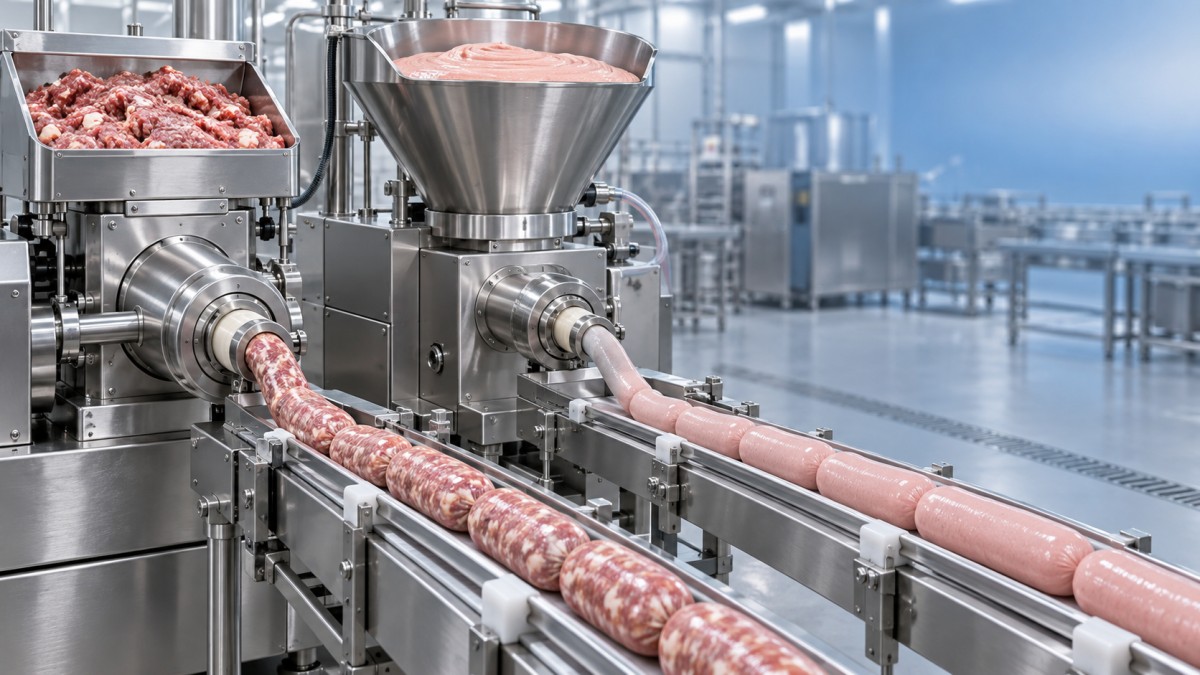
A piston filler uses a cylinder and piston to draw in product and discharge it through the filling outlet. The product is moved by positive displacement. This makes the process mechanically direct and relatively easy to relate to portion volume: each piston stroke displaces a defined quantity of batter. The system can be highly effective for products with stable flow characteristics, including many coarse-ground sausages, fresh sausage mixes, formed meat products, and products where visible particles must be moved without excessive agitation.
A vacuum filler combines feeding, conveying, and evacuation of air from the product stream. In common industrial configurations, the filling mechanism continuously transports product while maintaining a controlled vacuum in the hopper or product chamber. Removing air improves product density and can reduce voids in the filled casing. The result is particularly relevant for fine emulsions, cooked sausages, hot dogs, mortadella-type products, and other formulations in which a uniform cross-section and clean slice are important quality indicators.
Neither principle compensates for poor formulation control. Meat temperature, fat condition, protein extraction, hydration, chopping quality, and mixing sequence remain decisive. The filling machine can preserve a correctly prepared batter or reveal weaknesses in it; it cannot reliably correct an unstable emulsion.
Viscosity is more useful than a simple “thick versus thin” classification
Viscosity should be considered as a process behavior rather than a single laboratory value. A sausage batter may appear firm in the hopper but become more fluid under shear, or it may contain a matrix that resists movement until a threshold pressure is reached. These differences influence filling accuracy, drive load, and the risk of separation.
Piston fillers are often well suited to products with substantial body and relatively predictable flow resistance. Their positive-displacement action can provide stable transfer where a low-viscosity product might otherwise surge or drip. However, very stiff formulations may require high filling pressure. If the pressure needed to move the product rises too far, the machine may compact the batter, stress the casing, deform soft inclusions, or create inconsistency at the start and end of a fill cycle.
Vacuum fillers generally handle fine, cohesive batters efficiently because the product is continuously conveyed and deaerated. Their performance depends on the batter’s ability to feed into the conveying elements without bridging or separating. A very dry, poorly bound, or highly particulate mixture may not feed consistently. In such cases, the apparent advantage of vacuum can be offset by uneven conveyance, elevated mechanical stress, or incomplete particle transfer.
A useful evaluation method is to observe the product after it has remained in the hopper for a realistic production interval, not only immediately after mixing. If water, fat, or fine protein paste migrates during holding, the flow behavior at the filler can differ significantly from the behavior observed during a short trial.
Particle size and inclusion integrity can decide the choice
Coarse-ground formulations require more than an adequately sized outlet. The complete product path matters: hopper geometry, feed mechanism, valves, rotor or vane clearances, transfer elbows, stuffing tube diameter, and clipping interface can all affect the largest practical particle size.
Piston systems are commonly favored where visible cubes of meat, fat, cheese, vegetables, nuts, or other inclusions must retain their shape. The decisive factor is not merely whether a particle can pass through the nozzle. It must pass repeatedly without cutting, crushing, smearing, or causing intermittent blockage. A piston arrangement with broad, smooth product passages may be a sensible choice for low-to-moderate volume specialty products with large inclusions.
Vacuum filling is not limited to fine emulsions. Appropriately configured vacuum systems can process coarse materials, but the evaluator should examine the specific feed and conveying design rather than relying on a general equipment label. Conveying elements that work well with a homogeneous meat paste may damage fragile inclusions or alter the visual distribution of coarse particles. Product trials should inspect both the first and last portions produced, since ingredient segregation may develop over time in the hopper.
For formulations containing defined muscle pieces, frozen or semi-frozen raw material preparation also has an indirect effect on filling selection. Slices of frozen meat may be produced before grinding or mixing to reduce slow-thaw handling and support more controlled upstream processing. Equipment such as a Frozen meat shredder, designed to cut frozen blocks into slices before grinding and mixing, is relevant only when its cut size, meat temperature range, and throughput are aligned with the grinder and mixer that follow. An inconsistent upstream particle profile cannot be fully resolved at the filling stage.
Air removal affects more than appearance
Air incorporated during grinding, mixing, transfer, or hopper loading can create several downstream problems: pinholes in the finished product, variable density, poor slicing appearance, casing wrinkles, oxidation exposure, and weight variation when portions are controlled by volume. Vacuum filling directly addresses this variable by removing entrained air before or during stuffing.
The benefit is strongest when the product specification is sensitive to a compact, uniform internal structure. Fine emulsified sausage is the clearest example. Air voids can become visible after cooking and cooling, particularly when the product is sliced. A dense, air-reduced batter also tends to fill casings more uniformly, which can improve the consistency of linking, clipping, or molding operations.
Yet vacuum level should not be treated as an isolated quality setting. Excessive vacuum or unsuitable hopper conditions can contribute to product expansion, unstable feeding, or moisture loss at the product surface, depending on formulation and process temperature. The appropriate setting is the one that achieves stable density without disturbing the batter. It should be validated against finished-product texture, cooking loss, casing fill, and slice appearance rather than selected solely from a machine specification.
Portion accuracy depends on the measurement basis
Piston fillers offer an intuitive route to volumetric portioning because a cylinder stroke represents a known displacement. This can be advantageous for short-run production, manual or semi-automatic operation, and applications where repeatable volume is the primary requirement. But volumetric repeatability is not identical to weight accuracy. If batter density changes because of entrained air, temperature drift, ingredient separation, or compaction, the same displaced volume will produce a different weight.
Vacuum filling often improves weight consistency indirectly by producing a more uniform-density product stream. Continuous systems can also integrate portioning and linking functions at higher production speeds. This does not eliminate the need for checkweighing. A change in vacuum condition, feed rate, casing backpressure, or product rheology can still affect portion mass.
Evaluation should therefore distinguish between three questions: repeatability of the delivered volume, repeatability of finished unit weight, and consistency after thermal processing. A product that appears accurate at stuffing may show unacceptable cooked-weight variation if the emulsion is unstable or if cooking loss varies among portions.
Sanitation and changeover are design questions, not material claims
Food-contact stainless steel is important, but a sanitary filler is defined by accessibility and cleanability as much as by material grade. Both piston and vacuum systems should be assessed for drainability, tool-free access where appropriate, seal replacement procedures, dead spaces, product traps, and the ability to inspect parts that contact the batter.
Piston fillers may have fewer complex product-conveying components, but cylinder seals, valves, and transfer areas require close attention. Seal wear can affect both hygiene control and portion repeatability. Vacuum fillers can include more intricate conveying and vacuum-related components, making dismantling time, cleaning validation, and reassembly accuracy important operating considerations.
Where allergen-containing ingredients, cheese, vegetables, or strongly seasoned products are processed, changeover risk may outweigh a modest difference in nominal filling capacity. The preferred machine is the one that can be returned to a verified hygienic condition without leaving inaccessible residue in the product path.
What should be tested before committing to either system
A meaningful acceptance trial should use production-representative batter, casing, portion sizes, and operating temperatures. Testing only a smooth standard emulsion can produce a misleading result for a plant intending to run coarse, high-fat, high-inclusion, or low-moisture formulations.
- Measure portion weight over a sustained run rather than a few initial samples.
- Inspect cut surfaces after cooking and cooling for voids, fat smearing, and particle distribution.
- Observe hopper feeding after normal holding time, including any separation or bridging.
- Check the largest intended inclusion at the highest planned production rate.
- Record product temperature at filler inlet and outlet to identify mechanical warming.
- Evaluate casing fill, linking or clipping performance, and any increase in burst or wrinkle rates.
- Time cleaning and changeover with the actual product-contact configuration.
A piston filler is often the stronger technical fit when product variety, coarse structure, large inclusions, simple volumetric control, and moderate output are more important than maximum deaeration. A vacuum filler is generally the more appropriate choice when fine emulsions, dense appearance, high-speed portioning, integrated linking, and consistent internal structure are central to the product specification.
The final decision should follow the formulation, not the other way around. If the processor expects to run fundamentally different products on one line, the limiting formulation—usually the one with the largest particles, highest viscosity, or strictest density requirement—should define the evaluation protocol. That approach exposes whether the selected Sausage Filler can maintain product quality across the real operating range rather than only under ideal trial conditions.
Product Center
Leave a message online