
NEWS
The Total Cost of a Sausage Filler: Throughput, Cleaning, and Downtime
A sausage line can appear economical on the day the purchase order is approved and become expensive during the first busy production week. The filler may meet the required output on paper, yet operators spend too long changing products, cleaning paste from difficult areas, correcting portion weights, or waiting for a technician after a stoppage. In that situation, the purchase price is only a small part of the cost.
The practical way to evaluate a Sausage Filler is to calculate what it costs to produce usable, consistent product over its expected working life. Throughput, sanitation time, labor demand, product loss, spare-part access, and downtime should be assessed together. A lower-priced machine can be the better choice for a short, simple production schedule, but it can be the more costly option when output requirements, recipe changes, or hygiene demands increase.
Start with usable throughput, not the nameplate capacity
Rated capacity is useful, but it does not show how much finished sausage a line can actually produce during a shift. Real throughput includes the time required to load meat batter, attach casings, control portioning, replenish materials, remove air, change formats, and handle product at the discharge point. A filler that runs quickly for a few minutes but frequently waits for upstream preparation or downstream handling will not deliver its nominal output.
When reviewing capacity, procurement teams should map the complete process rather than comparing filler specifications alone. Ask how the machine will operate with the mixer, grinder, emulsion equipment, linking or clipping equipment, and packaging area. The slowest point determines the effective line rate. Oversizing the filler while leaving meat preparation undersized may create long waits, temperature-management concerns, and uneven labor utilization.
A useful internal calculation is not “kilograms per hour” in isolation, but planned daily saleable output divided by realistic productive hours. Productive hours should exclude routine cleaning, expected changeovers, loading delays, and normal adjustment time. This produces a more reliable capacity requirement and prevents paying for output that cannot be used by the rest of the process.
Cleaning time is a production cost, not a housekeeping detail
In sausage production, sanitation affects labor scheduling, product-change flexibility, and the time available for actual filling. Equipment with inaccessible corners, complicated dismantling, heavy components, or surfaces that retain meat residue can extend the cleanup period. The cost is not limited to water and chemicals: a longer washdown can delay the next product run or force cleaning staff to work outside the primary production window.
During evaluation, examine the product-contact path closely. Operators should be able to access the hopper, rotor or pumping area, seals, outlet, filling tubes, and other removable components without improvised tools or excessive lifting. Fast-release designs can reduce the time needed for routine access, but they should also be robust enough to withstand frequent use. A machine that is easy to open but difficult to reassemble correctly can introduce its own operational risk.
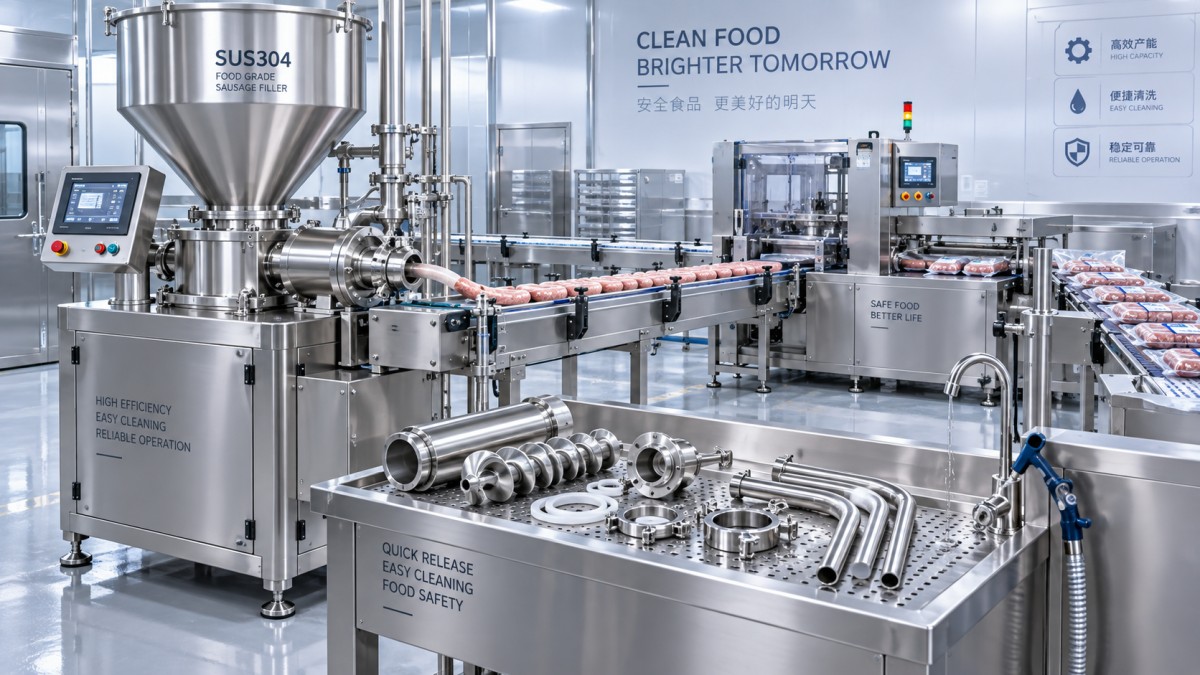
304 stainless steel is a practical material choice for food-processing equipment because it supports durable, cleanable construction in normal processing environments. Material alone, however, does not guarantee efficient sanitation. Surface finish, drainage, weld quality, gasket design, and the ability to inspect hidden areas all influence cleaning effectiveness. Request a clear explanation of the cleaning sequence and identify which parts must be removed between different recipes, allergen-control procedures, or end-of-shift sanitation.
Questions that expose hidden sanitation costs
- How many components need to be removed for a complete clean, and how are they identified for reassembly?
- Can one trained operator remove and reinstall routine product-contact parts safely?
- Are seals, filling tubes, and wear components easy to inspect before the next run?
- Does the machine retain product in low points, joints, or dead spaces after operation?
- What cleaning tools, replacement seals, and consumables are normally required?
The answers matter especially for plants running several recipes in one day. A filler with modestly lower purchase cost may lose its advantage if every changeover consumes enough time to remove an entire production opportunity.
Downtime should be separated into planned and unplanned loss
Planned downtime includes sanitation, routine inspection, setup, casing changes, and scheduled maintenance. These events can usually be managed by improving procedures and selecting equipment suited to the production pattern. Unplanned downtime is more disruptive because it affects orders, labor allocation, product temperature control, and upstream preparation. It may arise from worn seals, damaged cutting or pumping components, electrical issues, poor cleaning practices, incorrect adjustment, or inconsistent raw material preparation.
Decision-makers should not accept a general claim that equipment is “reliable” without asking how the machine is supported in daily operation. The relevant questions are whether routine wear parts can be identified early, whether components can be changed without major disassembly, and whether the operating team has clear guidance for basic fault isolation. Availability of compatible parts and service response arrangements should be reviewed before installation, not after the first stoppage.
A sensible maintenance discussion includes the distinction between components that are expected to wear and failures that indicate an operating problem. Seals, blades, plates, and moving elements may require planned inspection or replacement depending on product, operating hours, and cleaning practices. Repeated failure of the same part may point to excessive pressure, incorrect assembly, foreign material, unsuitable product temperature, or an upstream grinding issue. Treating every stoppage as a simple spare-parts matter can hide the real source of lost production.
Upstream meat preparation affects filler ownership cost
A filler cannot consistently perform beyond the condition of the meat batter it receives. Poorly prepared raw material can increase filling pressure, interfere with flow, create irregular texture, and accelerate wear in the product path. This is particularly relevant when processing frozen blocks, fresh meat, mixed raw materials, or formulations where sinew and connective tissue need controlled handling.
Where frozen or fresh meat is part of preliminary processing, a properly matched Frozen Meat grinder can help establish a more consistent feed for later mixing and filling. The available JRS130, JR120, JR200, and JR300 configurations are designed for meat-product preliminary processing, using SUS304 construction and different output capacities, power levels, and hole-plate ranges. Features such as independently operating double feeding screws, fast dismantling of feeding screws, multiple cutter and hole-plate combinations, and sinew-extracting capability can be relevant where raw material characteristics are contributing to downstream interruptions.
That does not mean a larger grinder automatically lowers cost. Select the hole size, output level, and preparation method around the actual recipe and filler requirement. Excessive mechanical treatment can affect texture, while inadequate preparation can make filling unstable. The value lies in matching the preparation stage to the consistency needed by the filler, not in specifying the highest-capacity machine available.
Labor cost is shaped by machine design and workflow
Labor should be evaluated as the number of interventions required per production run, rather than simply the number of people standing near the filler. An operator may need to load product, monitor casing feed, correct portions, clear minor blockages, move containers, record batch information, and clean equipment. When these tasks overlap, line speed often falls even though the filler itself remains capable of running.
Observe how material enters and leaves the machine. Is there adequate room for ingredient transfer? Can operators reach controls and product-contact components without awkward movement? Does the production layout allow one person to manage routine activity safely, or does it create repeated manual handling that requires assistance? These details influence staffing requirements every day, while their cost is rarely visible in the initial quotation.
Build a comparison that reflects your own production pattern
Before comparing suppliers, prepare a short operating profile: product types, expected batch sizes, casing formats, shift length, cleaning frequency, likely recipe changes, raw-material condition, and required output. Then ask each supplier to explain how the proposed configuration handles those conditions. A meaningful comparison should include the machine, necessary accessories, commissioning needs, routine wear items, cleaning requirements, and the expected relationship with upstream preparation equipment.
It is also useful to identify the cost of lost operating time internally. Even without assigning an exact monetary figure at the quotation stage, management can rank whether a delay creates minor inconvenience, missed dispatch capacity, overtime, product waste, or a complete line interruption. That ranking makes it easier to decide where a more durable design, easier sanitation access, or stronger service support is justified.
The right purchase decision is therefore not the filler with the lowest initial price or the highest advertised rate. It is the machine and process combination that delivers the required saleable output with manageable cleaning, stable product flow, predictable labor input, and downtime that can be controlled rather than repeatedly reacted to.
Product Center
Leave a message online