
NEWS
How a Meat Elevator Improves Material Flow Between Grinding and Mixing
How a Meat Elevator Improves Material Flow Between Grinding and Mixing
In a meat processing line, the distance between the grinder and the mixer may be short on a floor plan, yet it is often where production starts losing time. Ground meat is heavy, difficult to handle cleanly, and sensitive to delays in temperature-controlled workflows. When operators must push full bins, manually tip containers, or wait for forklift access, the line becomes dependent on movement rather than processing.
A Meat Elevator addresses that gap by creating a defined lifting and discharge route from the grinding stage to the mixer inlet. It is not simply a vertical conveyor. Properly integrated, it becomes the handoff point that keeps grinding, batching, and mixing working at compatible speeds while reducing unnecessary contact with the product.
For technical teams evaluating a new sausage, formed-meat, or prepared-food line, the useful question is not “Do we need an elevator?” It is: “What material-flow problem should the elevator solve, and what must happen if either the grinder or mixer pauses?” That distinction determines capacity, buffer strategy, discharge geometry, and cleaning design.
The transfer point is usually more fragile than it looks
Grinding produces material continuously or in relatively predictable batches. Mixing, however, operates in cycles. A mixer may be waiting for seasoning, ice, fat, or a quality check before a batch can begin. If ground meat has no controlled place to go during that interval, operators tend to improvise: park an open trolley beside the machine, wait with a loaded container under the grinder, or move product across the room. These workarounds can create congestion, additional cleaning burden, and avoidable variation in handling time.
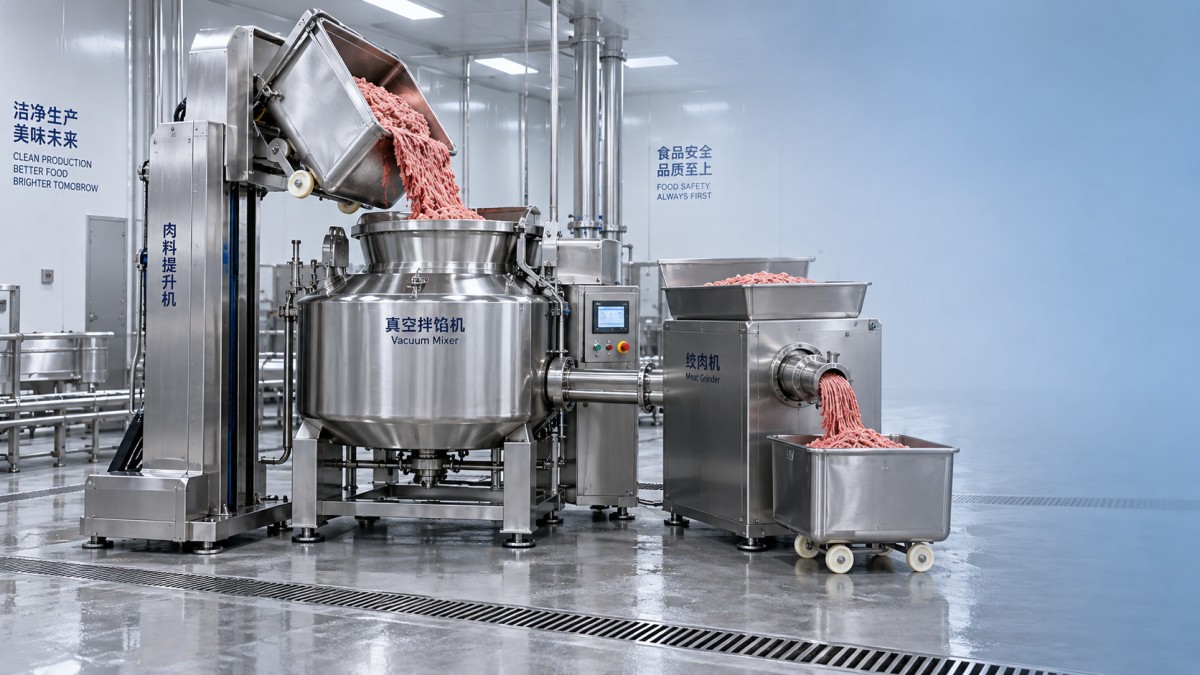
An elevator gives the line a repeatable route. The grinder discharges into a compatible receiving container or hopper; the lifting unit raises the load to the correct level; then the meat is tipped or discharged into the mixer in a controlled way. This layout reduces the number of manual touches and makes it easier to define responsibility for each transfer step.
That matters especially where multiple recipes run on one line. A poorly managed transfer zone is a common place for remnants of one batch to remain in a container, under a rim, or around a discharge point. The risk is not limited to visible product loss. In operations with allergen-containing seasonings or distinct product formulations, cleaning access and batch separation need to be considered before the equipment is installed, not after the first changeover proves awkward.
What a well-matched Meat Elevator changes on the floor
The most immediate improvement is a cleaner material path. Rather than carrying ground meat horizontally through an active work area, the product moves from a defined loading point to a defined discharge point. This can free floor space around the grinder and mixer, which is valuable in compact processing rooms where people, ingredient carts, washdown tools, and maintenance access already compete for space.
It also reduces the physical strain associated with lifting or tipping loaded containers. This is not a reason to ignore safe operating procedures, but it removes a task that is difficult to perform consistently by hand. In practice, consistent mechanical lifting is often gentler on both operators and equipment interfaces than frequent manual repositioning or forklift handling close to production machinery.
There is a throughput benefit as well, although it should not be oversold. An elevator does not make a grinder or mixer inherently faster. What it can do is reduce the idle time between them. If the grinder finishes a load and the mixer is ready, the transfer should be direct. If the mixer is not ready, the operation needs a deliberate holding arrangement rather than an operator standing with product in a trolley and no clear next step.
Capacity is about rhythm, not just load weight
One frequent specification mistake is selecting an elevator based only on the nominal batch weight of the mixer. That is a starting point, but it is not enough. The lifting system must match the actual rhythm of grinding, ingredient addition, mixing cycle time, and discharge time. A unit that carries the right load but takes too long to return, align, or discharge can still create a bottleneck.
Technical evaluation should therefore look at the entire transfer cycle: loading the receiving container, lifting, positioning at the mixer, discharge, return, and the time needed for cleaning or recipe change. It is also worth confirming whether the mixer requires a particular discharge height, feed angle, or hopper clearance. A layout drawing can reveal interferences that are easy to miss in a verbal discussion, such as a control panel blocking trolley movement or insufficient clearance for an elevator mast during maintenance.
The receiving container deserves the same attention as the elevator itself. A food-grade 304 stainless steel Meat Trolley can serve as a practical link between raw-material preparation, grinding, lifting, and mixing when its dimensions and lifting interface are compatible with the line. Smooth internal surfaces, no unnecessary dead corners, stable load capacity, and easy movement are not cosmetic details; they influence how quickly the container can be emptied, cleaned, and returned to service.
Hygiene depends on details that are easy to defer
In wet, protein-rich processing environments, elevator design should be reviewed through a sanitation lens. Food-contact areas should be accessible for inspection and cleaning. Surfaces should drain rather than hold moisture. Structural sections, guards, hinges, lifting hooks, and discharge interfaces all need practical access; “washable” is not the same as “easy to verify clean.”
304 stainless steel is widely used for food processing equipment because it offers a durable, hygienic base material for many applications. Even so, material selection alone does not guarantee a hygienic installation. Weld finishing, surface condition, drainage, sealing arrangement, and the suitability of the cleaning method all affect long-term results. Where chemicals, salt exposure, or particularly aggressive washdown conditions are involved, the final specification should be reviewed against the actual plant environment.
A sensible design review should also ask where product can fall during normal operation. Fine mince can accumulate around receiving edges, at the discharge lip, or beneath the mixer feed point. Installing a unit without allowing sufficient cleaning clearance below and behind it can turn a promising flow improvement into a daily sanitation frustration.
Choosing the right configuration for the line
The best Meat Elevator configuration depends on the product format and the degree of automation already present. A smaller operation may prioritize flexible trolley-based handling because the same container can move raw material, ground meat, and intermediate batches. A higher-throughput line may require a more fixed connection between grinder, lift, and mixer, with controls that prevent discharge until the receiving machine is ready.
- Confirm the required discharge height and the actual opening dimensions of the mixer.
- Match container volume to usable batch size, allowing for safe loading rather than filling to the rim.
- Check whether the elevator can safely interface with existing trolleys, grinders, and mixers.
- Review guarding, interlocks, emergency stops, and access points with the plant’s safety requirements in mind.
- Plan for washdown, drainage, and maintenance access before fixing the final equipment position.
It is tempting to specify the shortest possible route between machines. Sometimes that is correct; sometimes it leaves no space for operators to load, clean, or service the equipment safely. A slightly longer but more accessible layout can be the better production choice over time.
Integration should be treated as a line decision
A meat elevator works best when it is selected as part of a connected process rather than as an isolated accessory. Grinder output, trolley handling, mixer inlet design, control logic, and sanitation routines should be considered together. Suppliers offering one-stop meat, sausage, and pasta processing equipment can often help review these interfaces early, particularly where 304 stainless steel equipment must be matched across several stations.
Before approving a configuration, walk through one real production sequence: loading raw material, grinding, temporary waiting, transfer, mixing, discharge, cleaning, and the next recipe. The places where staff would need to reach, wait, push, or improvise are usually the places where the material-flow design still needs work. A properly specified elevator does more than lift ground meat—it makes the handoff between two critical processes predictable, cleaner, and easier to manage every shift.
Product Center
Leave a message online