
NEWS
Meat Elevator Selection by Load Capacity, Discharge Height, and Batch Size
Select a Meat Elevator from the transfer duty first, then confirm that its discharge geometry and batch rhythm fit the surrounding machines. A unit that appears adequate from a nominal capacity figure can still interrupt production when the hopper receives uneven charges, the discharge point is too high for the receiving inlet, or the elevator must wait for a downstream batch process to finish. The useful specification is therefore the combination of payload per lift, lifts per hour, vertical travel, product condition, and the time available to discharge.
For meat processing, the conveyed material is rarely uniform. Lean trim, fatty pieces, chilled meat blocks, frozen pre-cut material, and mixed ingredients create different loading behavior. Their flow across the hopper, belt, screw, or lifting carrier affects both usable capacity and cleaning access. The selection should reflect the heaviest realistic operating condition rather than an idealized loose product load.
Start With the Required Material Flow
Load capacity has two distinct meanings: the maximum weight carried in one lifting cycle and the average mass transferred over time. Confusing these values is a common source of undersized equipment. A machine may safely lift a heavy batch but still fail to maintain line flow if the loading, lifting, tipping, and return sequence takes too long.
Calculate the required transfer rate from the actual upstream discharge pattern. If a grinder, mixer, tote dumper, or trimming station sends material continuously, the elevator needs enough live capacity and cycle frequency to avoid accumulation. If material arrives in discrete tubs, match the payload to the tub charge and consider the time required for alignment and loading. Do not assume that a hopper filled to its physical volume will deliver its stated weight; product density changes with cut size, temperature, fat content, and how tightly the material settles.
Capacity margin should not be interpreted as permission to overload the feed hopper. Repeated overload affects drive loading, guide wear, and the stability of a raised load. It can also create spillage at the transfer point, especially when irregular meat pieces bridge near the discharge edge. A better approach is to specify the expected working load, the occasional maximum load, and the intended cycle rate separately.
Discharge Height Is a System Dimension
Discharge height should be measured against the receiving machine's actual loading point, not simply the height of its frame. The relevant elevation may be the top of a cutter bowl, the inlet of a vacuum mixer, a hopper opening, or a transfer chute. The elevator must also have adequate clearance to tip, discharge, and return without contacting guards, pipework, cable trays, or overhead structures.
A high discharge point increases the structural and drive demands on the equipment. It also magnifies the effect of an unstable base, poor floor condition, or a load that shifts during lifting. For this reason, vertical travel should be reviewed with the installation footprint and center of gravity rather than treated as an isolated number. Floor anchors, service access, guarding space, and washdown drainage can alter the practical layout even when the elevation drawing appears workable.
The receiving angle matters as much as height. A discharge that drops material vertically into a wide vessel has different requirements from one that must feed through a narrow opening. Large pieces may rebound from a hard surface, while sticky meat fillings may cling to a chute or hopper wall. Where the downstream inlet is narrow, the transfer path should be checked for product hang-up and for access needed to remove residual material during sanitation.
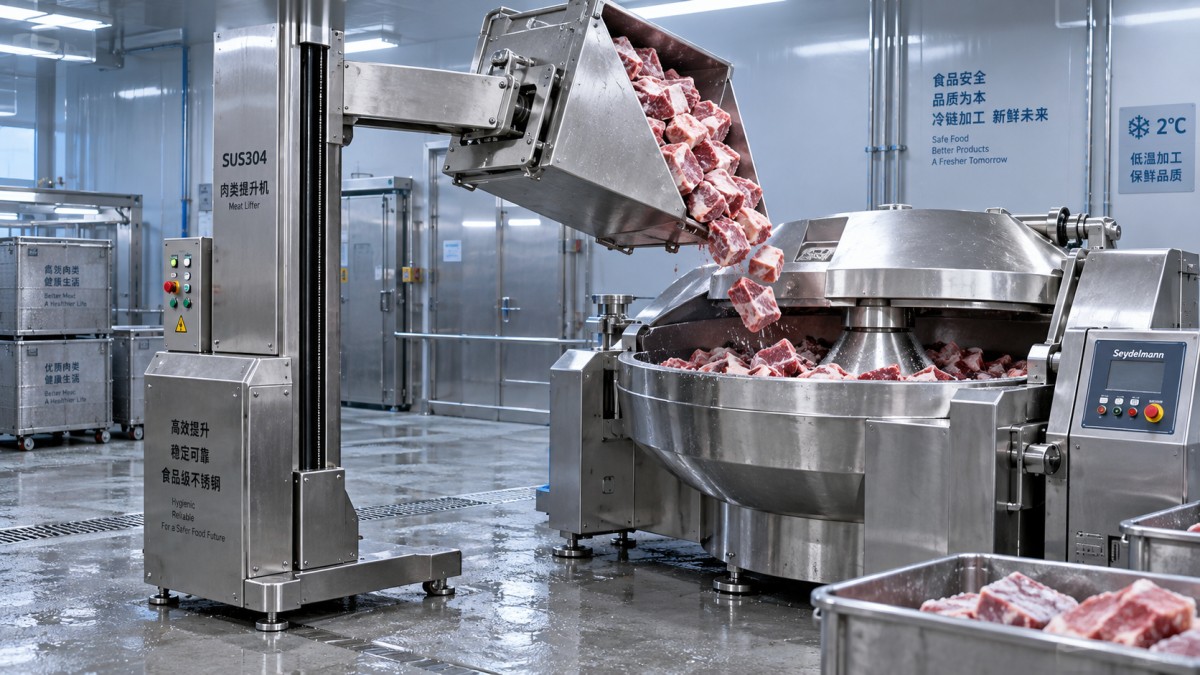
When feeding a Bowl cutter, verify the bowl rim height, available loading area, and whether the process requires product to enter in a controlled portion rather than as a fast, concentrated dump. Fresh chilled meat and pre-sliced frozen material can behave differently at the point of release. The elevator should suit the cutter's batch sequence without exposing the bowl area to unnecessary splashing or creating a manual intervention point.
Batch Size Changes the Best Configuration
Batch size affects more than hopper volume. It determines how often the lift moves, how long the receiving machine remains open, and whether the line works as a steady transfer process or as a series of timed handoffs. Small batches often favor rapid, repeatable cycles because excessive hopper volume leaves more residue after each transfer. Larger batches reduce the number of lifts, but impose greater demand on the lifting frame and may require longer downstream receiving time.
Match the elevator's usable hopper volume to the intended batch, allowing space for uneven product surfaces and safe movement. A nominally full hopper packed with cubes or frozen slices can exceed the desired mass before it looks full. Conversely, a light, aerated mixture can reach the volume limit without reaching the required batch weight. Where formulations require tight batch control, weighing should occur at the appropriate point in the process; hopper volume alone is not a reliable dosing method.
Batch size also influences cleaning decisions. A large hopper may be efficient for high-volume transfer, yet it presents a larger surface area and more corners where product can remain after discharge. Smooth internal surfaces, drainage-aware geometry, accessible covers, and a 304 stainless steel product-contact structure support hygienic handling, but they do not eliminate the need to inspect the discharge zone, underside of the hopper lip, and any product guides after a run.
Evaluate the Transfer Interface, Not Only the Elevator
The two interfaces deserve close attention: loading into the elevator and discharge into the next machine. At the loading side, confirm the height and orientation of tubs, conveyors, or feeding equipment. An awkward approach can lead to inconsistent hopper filling, spilled product, or a need for temporary ramps that were absent from the original layout. At the discharge side, define whether the next machine requests a full batch, accepts continuous feed, or needs an interlocked release signal.
- Record the maximum actual load, including any retained liquid, ice, or ingredients transferred with the meat.
- Use the receiving inlet elevation and clearance envelope rather than a single discharge-height figure.
- Confirm the product form: coarse chilled pieces, frozen slices, and sticky emulsified material place different demands on hopper shape and discharge surfaces.
- Review the complete cycle: loading, ascent, discharge, return, and the downstream machine's ready time.
- Reserve access around drives, guides, safety devices, and washdown areas before finalizing the equipment position.
Safety devices should support the real transfer sequence. Raised-load protection, guarded moving parts, stable load retention, and controlled discharge are especially relevant where repeated batch lifting occurs near adjacent equipment. Interlocks must be coordinated with the downstream machine so product is not released into a closed cover, an occupied vessel, or a process stage that has not completed its cycle.
A suitable Meat Elevator is defined by a balanced duty: enough payload for the heaviest normal batch, enough vertical reach for the real receiving point, and a cycle pattern that neither starves nor overwhelms the next process. Reviewing those conditions together prevents a layout that works on paper but creates delays, residue, or unstable handling once production begins.
Product Center
Leave a message online