
NEWS
Safety Interlocks to Check Before Buying a Meat Elevator for Production
Safety Interlocks to Check Before Buying a Meat Elevator for Production
A lifting and dumping system can remove one of the most physically demanding steps in a meat processing line: moving loaded meat carts to the inlet of a grinder, mixer, vacuum tumbler, sausage filler, or hopper. It can also introduce a concentrated safety risk. A cart is heavy, the load may shift, the machine operates at height, and operators often work nearby during loading, cleaning, or changeover.
For quality and safety teams, the purchase decision should not begin with lift height or hourly output. Those figures matter, but the more useful question is simpler: what happens if an operator opens a guard, a cart is not seated correctly, a product jam occurs, or the lift reaches an unexpected position? A suitable machine should move into a safe state before that condition becomes an injury, a contamination event, or a damaged downstream machine.
Interlocks are not just buttons on a control panel. They are the coordinated safeguards that prevent hazardous movement, restrict access to pinch points, verify cart position, and stop or inhibit operation when conditions are wrong. Their design deserves the same scrutiny as hygienic welds, drainage, and cleaning access.
Emergency stops must be reachable from the real work positions
An emergency-stop device should be accessible where people actually stand: at the loading point, near the discharge point where practical, and at the operator control station. During a busy run, an employee may be guiding a cart into the retention mechanism rather than standing neatly in front of the panel. If the only emergency stop is behind the machine or beyond a moving cart, it may be present on paper but ineffective in a real incident.
Ask the supplier to demonstrate the stop sequence. Does activation stop lifting and lowering motion immediately? Does it prevent an automatic restart when the button is reset? Restart should require a deliberate command after the source of the problem has been checked. A system that resumes movement simply because power returns can create an unpleasant surprise after cleaning, maintenance, or a brief power interruption.
Also separate emergency stopping from electrical isolation. An emergency stop is not normally a substitute for a lockable main isolator used during maintenance. Teams should confirm how lockout/tagout procedures can be applied to the machine and any connected equipment.
Guard doors and access panels need monitored interlocks
The main hazard areas are usually obvious once the lift begins moving: chain or screw drive sections, carriage travel zones, cart clamps, pivot or tipping points, and the discharge area. Fixed guards protect areas that do not need routine access. Where access is necessary for sanitation or inspection, a movable guard or door should be fitted with an interlock that prevents hazardous motion while open.
It is worth asking a direct question during evaluation: can the guard sensor be easily defeated with a loose magnet, tape, or a simple mechanical trick? In food plants, guards are sometimes opened frequently because an area is difficult to clean or product accumulates around it. That is exactly when bypassing becomes tempting. A well-designed arrangement makes normal sanitation practical without normalizing unsafe shortcuts.
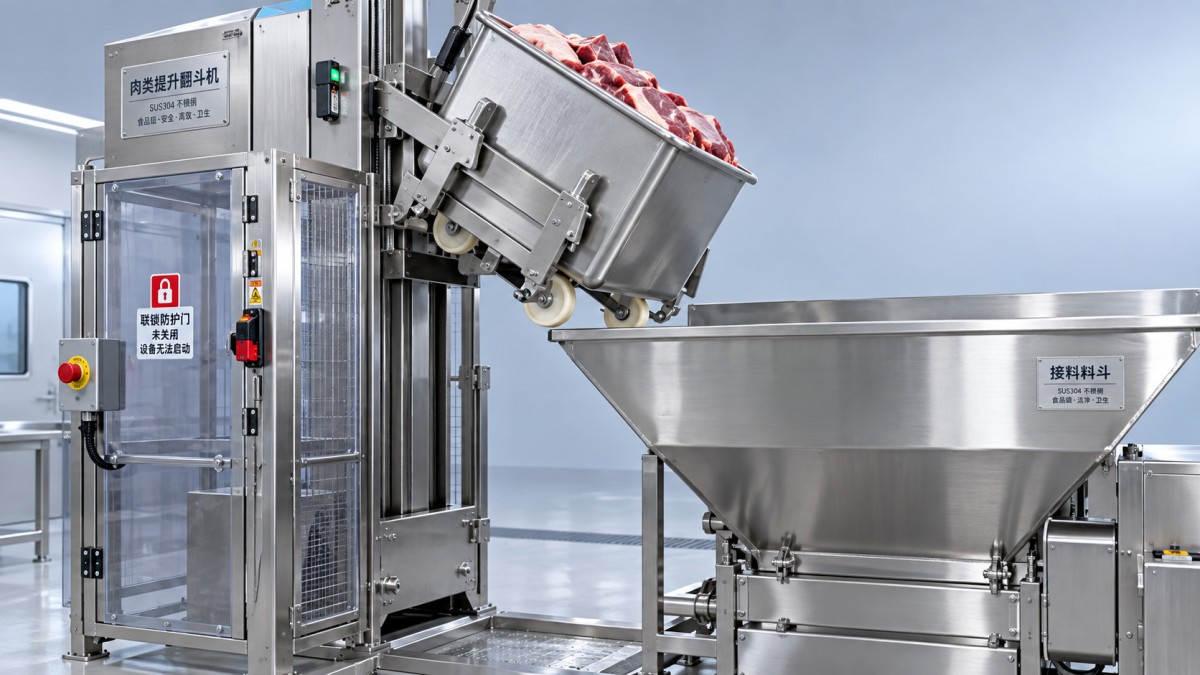
For equipment that flips a cart into a hopper, assess the discharge zone separately. The hazard does not disappear when the carriage stops at the top. A person reaching beneath a raised cart or toward the hopper may still be exposed to gravity, residual movement, or a downstream agitator. The control logic should account for the full transfer sequence, not merely the vertical lift.
Cart detection and retention are the interlocks that protect the process
A lift that accepts standard meat carts needs more than a broad loading platform. It needs a reliable way to confirm that the cart is fully located and retained before it travels. This may involve mechanical latches, locating features, limit switches, or other position-confirmation devices. The specific design can vary, but the operating principle should be clear: no lift cycle or tipping cycle until the cart is secure.
Quality personnel should look beyond whether the cart “fits.” Cart fleets often include units from different production periods, carts with worn wheels, repaired frames, or slightly different dimensions. If the facility uses more than one cart type, test representative carts rather than approving the machine with one new, empty sample. A loaded cart can behave differently, particularly if meat is unevenly distributed or partially frozen.
The same principle applies at the receiving end. The elevator should not discharge if the target hopper is not ready, if a receiving guard is open, or if the downstream machine has signaled a fault. Product dropped into a stopped or inaccessible hopper can create both a sanitation problem and a difficult manual recovery task.
Upper and lower travel limits should not rely on one device alone
Every lifting system needs defined upper and lower limits. The normal operating limit tells the control system where to stop. A separate overtravel protection method is commonly expected as a backup if the normal limit does not operate as intended. Buyers do not need to prescribe the engineering solution, but they should ask the supplier to explain the primary and backup protection arrangement.
This is especially important when ceiling clearance is tight or when the discharge height is matched closely to a mixer or hopper. A few centimeters of unexpected travel can damage guarding, strain a drive, or interfere with an overhead service line. Confirm the required installed footprint, including service clearance, rather than relying only on the machine dimensions. For example, a TS200 configuration is listed at 1450×1250×2900, but final layout still depends on cart approach space, discharge geometry, and maintenance access.
Do not overlook lowering protection. The lowest position should be stable for loading, and motion should stop before the carriage, cart, or operator’s footwear can enter a pinch zone near the floor. A clean floor is essential, but it is not a safety control by itself.
Overload, drive fault, and unexpected-motion protection deserve a practical review
A machine should respond safely to overloads, stalled motion, abnormal motor load, and mechanical obstruction. The correct safeguards depend on whether the design is chain type or screw type and on the drive arrangement. What matters during procurement is that a fault does not lead to uncontrolled travel, a dropped cart, or repeated attempts to force movement through an obstruction.
Request a clear description of fault indication and recovery. Can operators see why the machine stopped? Is there a defined reset procedure? Can they jog the system only under controlled conditions when clearing a jam? Vague instructions such as “restart after inspection” are not enough for a line where production pressure is high. The safer choice is usually the machine whose recovery steps are understandable to trained operators and documented for maintenance staff.
Electrical compatibility should be checked early. One available configuration is specified for 3PH 380V 50HZ with 1.1 power listed in its technical data. These figures should be verified against the site supply, local electrical requirements, and the final control package. Capacity, speed, and height figures should likewise be confirmed with their units and operating conditions before they are used for line balancing.
Hygienic construction affects whether interlocks remain reliable
Safety and hygiene meet at the machine surface. Meat residue, washdown moisture, and cleaning chemicals can affect switches, cable entries, hinges, and guard alignment over time. A robust stainless-steel frame is useful, but buyers should inspect the details: smooth accessible surfaces, protected sensors, sealed electrical components appropriate to the washdown routine, and areas that do not trap product or water.
For food-contact or splash-prone environments, many processors prefer 304 stainless steel for its cleanability and durability, while the precise material specification should be checked against the plant’s cleaning chemistry and process conditions. Sensors hidden behind hard-to-clean brackets may remain functional at commissioning yet become a sanitation headache later. Ask who cleans the component, how it is accessed, and whether removal or adjustment changes its safety setting.
What to witness before signing off
A factory or site acceptance check should include more than a smooth empty cycle. Have the supplier demonstrate attempted operation with an open access guard, an incorrectly positioned cart, an emergency stop activated, and a simulated downstream “not ready” signal. Observe whether the machine provides a meaningful alarm and whether it requires an intentional reset. Review the operating manual, electrical drawings, cleaning instructions, spare-parts list, and the inspection points for sensors, chains, screws, and retaining devices.
A semi-automatic lifting system can be a sensible answer to repetitive manual feeding when its safeguards fit the actual line. The Meat Elevator designed for meat product processing lines is intended to lift standard carts, flip and dump material, and feed a processing hopper with controlled operation. That function is useful only when cart retention, door sensing, travel limits, and downstream permissions are verified as a working whole.
The best procurement decision is rarely the unit with the longest feature list. It is the one whose interlocks can be tested, cleaned, understood, and maintained without encouraging people to work around them. Before release, walk the intended loading, lifting, discharge, cleaning, and fault-recovery routes with operations, maintenance, and sanitation staff. Their questions usually reveal the interlocks that matter most.
Product Center
Leave a message online