
NEWS
Meat Elevator Spillage and Product Loss: Causes at the Tipping Stage
A Meat Elevator can lose product long before the meat reaches the next machine. The highest-risk moment is usually the tipping stage: the point where the hopper rotates and releases meat, trim, ground product, or emulsified material into a mixer, grinder, filler hopper, or transfer chute. When discharge is unstable, the visible loss on the floor is only part of the problem. Product can collect on ledges, fall behind guarding, smear onto difficult-to-clean surfaces, or force repeated line stops for recovery and sanitation.
The practical question is not simply whether the elevator lifts safely. It is whether the complete discharge path controls the product from the hopper until it is fully received by downstream equipment. A stable lifting mechanism cannot compensate for poor alignment, an excessive discharge gap, or a hopper geometry that releases product in an unpredictable mass.
Where tipping-stage spillage usually begins
Most loss events trace back to a small number of mechanical and process conditions. These conditions often interact, so replacing one component without checking the full transfer path may only move the problem elsewhere.
A frequent mistake is to treat all product loss as an operator issue. Operator timing matters, but repeated spill patterns usually indicate a design or integration problem. If the same location requires routine wiping, catching, or scraping, the transfer arrangement needs attention.
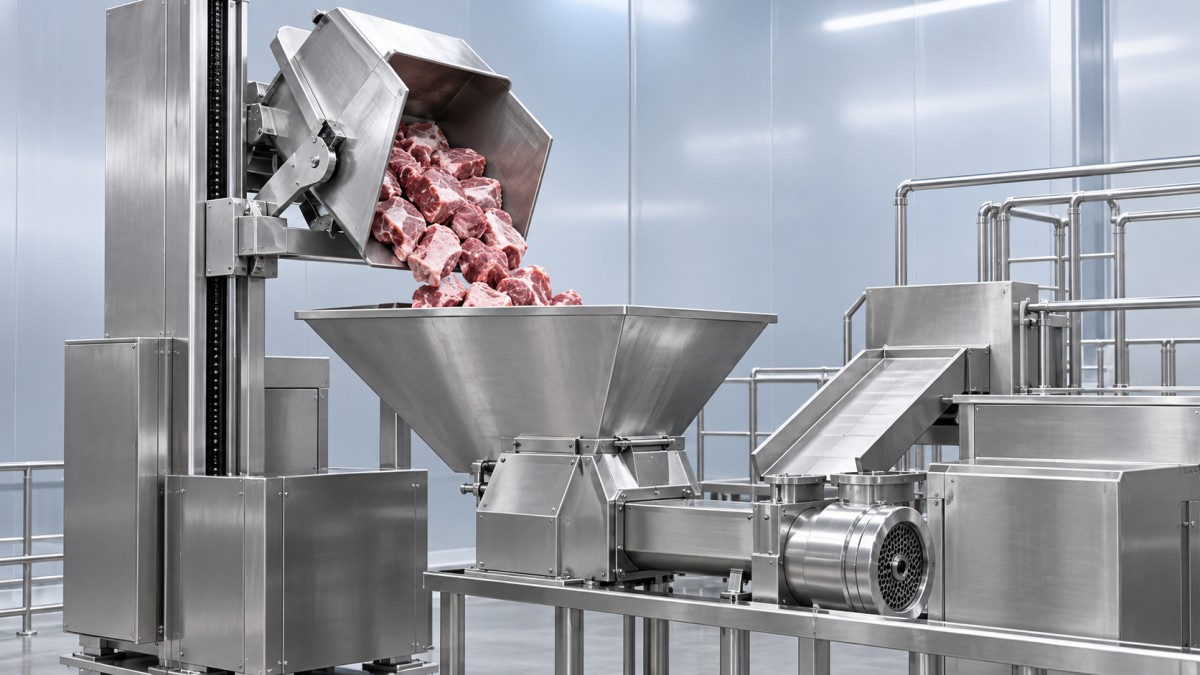
Alignment is more than matching two centerlines
During evaluation, it is tempting to confirm the static centerline of the elevator hopper against the centerline of the receiving hopper. That check is necessary, but it is incomplete. The effective discharge point changes as the container rotates. Product may leave from the front lip, one side of the hopper, or a later-release zone near a corner, depending on its texture and the hopper profile.
The receiving opening must therefore accommodate the full discharge envelope, not just the hopper position when upright. A narrow inlet may work with compact frozen blocks but fail with loose diced meat. Ground meat and sticky marinated material can release as a delayed mass, producing a sudden sideways surge near the end of the tipping cycle.
Where practical, use a receiving hopper with sufficient opening area and a guide section that directs product inward rather than creating a sharp edge. The guide should be accessible for cleaning and should not introduce narrow crevices where residue can remain. A long enclosed chute is not automatically better: if its slope is too shallow or its surface is poorly finished, it can retain product and create a separate cleaning problem.
Control the drop, not only the lift
Excessive free-fall distance is one of the clearest contributors to scattered product. It is particularly problematic with bone-in pieces, firm chilled cuts, frozen materials, and products that can rebound after impact. Reducing the gap between the hopper discharge and the receiver is normally more effective than adding guards around an already uncontrolled drop.
The target is not always the shortest possible distance. The elevator must still clear downstream equipment, allow cleaning access, and avoid collision as the hopper tips. The useful design objective is a short, contained, unobstructed path with enough room for the actual product stream.
Discharge speed matters as well. A fast lift can be valuable for cycle time, but a fast final rotation may dump the load as one dense mass. Controlled tipping, especially near the point where the product first begins to move, gives the receiving machine time to accept the material. This is important when feeding equipment with a limited hopper volume or a screw, paddle, or vacuum system that cannot absorb sudden surges.
Product behavior changes the correct elevator configuration
A Meat Elevator should be assessed against the product in its least predictable condition, not only against a clean, easy-flowing sample. Fresh chunks, lean trim, fatty trim, marinated cuts, frozen pieces, and ground meat behave differently at discharge. Cold, sticky, or high-fat material may cling to the hopper until the angle becomes steep, then release abruptly. Drier, separated pieces may begin moving early and spread across the discharge lip.
This is why hopper geometry and interior finish deserve close review. Smooth, sanitary 304 stainless steel construction supports cleaning and durability, but material release also depends on weld finishing, corner transitions, drainage details, and the absence of product-catching features. A polished surface cannot solve a hopper that has dead corners or an insufficient tipping angle for the intended product.
For variable production, evaluate whether the equipment can support repeatable settings for different recipes and load sizes. The relevant settings may include lift speed, tip speed, stopping position, dwell time, and the receiver position. A setup that works for a full tote may behave differently with a partial load.
Check the downstream machine before specifying the elevator
Elevator selection is often isolated from the equipment it feeds. That creates avoidable problems. The receiver may have a lid opening that is too small, a raised rim that deflects product, or an internal component positioned directly under the drop point. The downstream process may also be the real bottleneck.
For sausage production, material transfer should be reviewed as part of the full sequence from preparation through filling and closure. A clipper can link with quantitative filling equipment and operate at an adjustable production speed, but stable clipping does not correct inconsistent upstream supply. When evaluating a Sausage Clipper for an automated sausage line, confirm that the elevator, receiving hopper, filler capacity, and clipping rhythm are matched as one system. Otherwise, upstream overflow or delayed feeding can appear as a filling or clipping issue even when the root cause is uncontrolled transfer.
A practical tipping-stage inspection
Before approving a layout or investigating recurring loss, run the actual product through a full cycle and inspect the transfer at normal production conditions. A useful review sequence is:
- Observe the first point at which product moves inside the hopper. Early movement can indicate insufficient containment; late movement can indicate sticking and sudden release.
- Watch where the product first contacts downstream equipment. A rim strike, sidewall impact, or hard deflection is a likely source of bounce and residue.
- Check the final hopper position for retained product, especially around corners, seams, and the discharge lip.
- Assess whether the receiver can accept the full load without temporary blockage or overflow.
- Inspect splash zones, guards, machine bases, and floor edges after several cycles. These locations reveal losses that are not obvious during a single tip.
- Repeat the observation with realistic variations in batch size and product condition.
Do not rely only on a dry run or an empty hopper cycle. The mechanical travel may look correct without product, while the real discharge path remains uncontrolled.
When guards help and when they hide the problem
Side guards and containment panels can reduce exposed splash zones, particularly where layout constraints prevent a close transfer. They are useful as secondary protection, provided they are open enough for inspection and cleaning. They should not become a substitute for correcting poor alignment or an oversized drop.
Guards that trap product are a hygiene risk. They may conceal recurring loss until residue accumulates, and they can make sanitation verification harder. Any containment feature should have smooth accessible surfaces, drainage where needed, and a clear purpose in the product path.
The most effective approach is to reduce loss at its source: align the moving discharge envelope with the receiving opening, minimize uncontrolled drop, match tipping speed to receiver capacity, and validate the system with the actual meat product. Once these points are addressed, protective guarding becomes a support measure rather than the primary solution.
For equipment planning, treat the elevator as part of the processing line rather than a standalone lifting device. A coordinated meat, sausage, and pasta processing equipment layout, built with sanitary 304 stainless steel contact structures where appropriate, makes it easier to control transfer losses, clean the system efficiently, and maintain predictable production flow.
Product Center
Leave a message online