
NEWS
Matching Meat Elevator Controls with Mixers, Grinders, and Vacuum Fillers
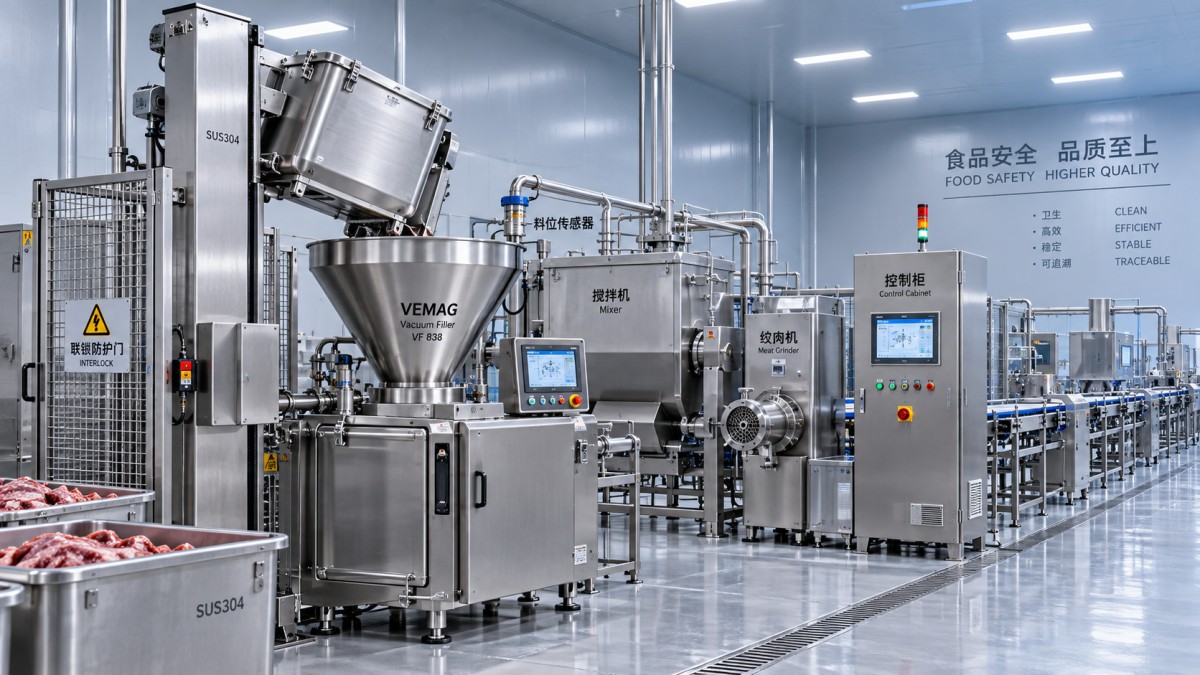
A meat elevator is not merely a lifting device between process stations. Its control system determines whether the mixer, grinder, and vacuum filler operate as one controlled material path or as separate machines joined by manual intervention. The correct match is defined less by the elevator’s travel height than by how its discharge cycle responds to downstream demand, upstream availability, hygiene constraints, and safety states.
For fresh meat, emulsions, and sausage batter, a poorly integrated elevator can create several problems at once: grinder starvation, hopper overfilling, inconsistent batch transfer, product temperature exposure, and unnecessary operator access around elevated loads. A technically sound specification starts with the process sequence and control responsibilities, not with a generic “automatic” option.
Start with the material-transfer logic
Control compatibility depends on what the elevator is expected to move and where it sits in the line. A bin elevator feeding a grinder behaves differently from one discharging mixed meat into a vacuum filler hopper. In the first case, the primary task may be preventing the grinder from running empty while avoiding excessive feed pressure. In the second, the system may need to preserve batch identity, prevent a filled hopper from overflowing, and avoid interrupting a filling cycle at the wrong moment.
The basic control question is whether the elevator should operate:
- as a manually commanded standalone unit;
- as a machine with local automatic discharge control;
- as a follower of downstream equipment; or
- as one node in a PLC-controlled line sequence.
These arrangements are not interchangeable. A local push-button control can be sufficient where an operator deliberately transfers discrete batches from a mixer to a receiving hopper. It is inadequate when an elevator must automatically respond to a grinder’s hopper level or to a vacuum filler’s production state. Conversely, a full line PLC is not automatically justified for every short process line; it adds integration work and requires clear ownership of alarms, recipes, cleaning modes, and fault recovery.
Matching the elevator to a mixer discharge
Mixers commonly create a batch-based upstream condition. The elevator must know when the mixer has completed its cycle, when the mixer discharge is permitted, and whether the receiving station is ready. If the mixer and elevator are independently operated, a simple permissive arrangement may be enough: the elevator cannot start unless its bin is correctly positioned, the safety gate is closed, and the upper discharge point is confirmed available.
More coordinated systems use dry contacts or fieldbus signals to exchange states such as “mix complete,” “discharge enabled,” “bin in position,” and “transfer complete.” The exact signal list matters. A signal labelled “run” is not a substitute for a confirmed process-ready state. A mixer can be powered and ready while still being in a timed mixing phase, under a safety interlock, or awaiting an operator confirmation.
Batch handling also affects the level of integration needed. Where recipes include separate additions or tightly controlled lean-to-fat proportions, the elevator should not be treated as a neutral transport step. The control logic must avoid combining residual product from one batch with the next unless that carryover is acceptable under the plant’s formulation and traceability rules. This may require a bin identification procedure, a discharge-complete confirmation, and a defined protocol for partial loads.
Elevator capacity should be checked against mixer batch size, but control capacity is equally important. A lift that can physically hold a full batch may still be poorly matched if its discharge is too abrupt for the next machine or if its cycle time leaves the mixer waiting. The useful comparison is not nominal kilograms per hour alone; it is the time needed to load, lift, dock, discharge, return, and become available for the next batch.
Feeding grinders without creating unstable load conditions
Grinders impose a more continuous demand pattern than mixers. Their feed requirement changes with plate condition, product temperature, meat cut, fat level, auger loading, and whether frozen or tempered material is being processed. An elevator positioned above the grinder should therefore be evaluated as part of the grinder’s feed-control strategy.
The simplest arrangement uses a high-level switch in the grinder hopper. When the product level falls below a set point, the elevator is called to discharge; when the upper level is reached, discharge stops. This can work for coarse transfer, but its limitations are important. Point-level devices react after the product level has already changed, and meat does not always flow uniformly. Bridging, product adhesion, and irregular particle size can produce a misleading level condition.
A better technical review asks how the elevator discharges: by tipping a bin, opening a gate, running a belt, or using another mechanism. A full-bin tip discharge can deliver a large slug of meat. If the grinder hopper has limited free volume, the controls need a permissive confirming hopper capacity before the lift begins its tipping sequence. A gate-controlled discharge may offer finer modulation, but it introduces more components that must be cleaned, inspected, and interlocked.
Where variable-speed feeding is used downstream, the elevator does not necessarily need proportional speed control. It does need coordinated start-stop logic that avoids repeated short cycling. Excessive cycling increases mechanical wear and can create inconsistent hopper loading. Hysteresis between low and high level thresholds, minimum run times, and a sensible alarm delay are generally more useful than aggressively sensitive level settings.
The grinder’s stop condition must also be considered. If an emergency stop, overload trip, guard opening, or sanitation mode stops the grinder, the elevator must be prevented from discharging product into a non-operational or inaccessible hopper. This is a basic permissive requirement, not an optional automation enhancement.
Vacuum filler integration requires tighter state control
Vacuum fillers introduce different risks because hopper supply directly affects portioning continuity, vacuum stability, and product handling. A filler may include its own hopper-level sensing and request signal, but an elevator should not be assumed compatible simply because both machines have an “auto” mode.
Compatibility should be checked at three levels. Electrical compatibility concerns voltage, control supply, signal type, grounding, and whether inputs and outputs are dry contacts, 24 VDC signals, analog signals, or network communications. Functional compatibility concerns what each signal actually means: request, ready, running, faulted, hopper full, or cycle complete. Operational compatibility concerns whether the machine sequence makes sense when a fault occurs or when product transfer is interrupted.
For example, a vacuum filler may request material when its hopper reaches a low level. If the elevator needs a lengthy lift-and-tip cycle, the request must occur early enough to prevent starvation. If the filler’s request is interpreted as an immediate command without a receiving-capacity check, a delayed or interrupted filler cycle can lead to overfilling. The preferred arrangement is a handshake: the filler requests product, the elevator confirms it is available and safe to operate, the filler confirms that receiving is allowed, and the elevator reports transfer completion or fault status.
Signal documentation should identify whether contacts are normally open or normally closed, whether fault signals are fail-safe, and how communication loss is handled. An ambiguous interface sheet is a common source of commissioning delays. “Connection available” is not enough detail for a control review.
Safety circuits must remain independent of production convenience
Elevators combine vertical motion, suspended loads, pinch points, and elevated discharge. Safety functions should not depend solely on ordinary PLC logic or on an operator’s visual judgement. The required design will vary by jurisdiction and risk assessment, but the technical evaluation should distinguish clearly between process interlocks and safety-rated functions.
Typical protective elements include emergency-stop circuits, upper and lower travel limits, bin-position confirmation, guarding or gate interlocks, overload protection, and prevention of unintended restart after a power interruption. If an elevator tips into an open hopper, the condition of that hopper’s guard, lid, or receiving interface can also be relevant. A production command should never override a safety condition simply to preserve throughput.
Fault recovery deserves attention. After an emergency stop or a sensor fault, does the lift require a deliberate reset and an inspected safe position, or can it resume automatically when the input changes? Automatic recovery may be undesirable where an operator could be near the discharge area or where a partly tipped bin creates an uncertain load condition.
Sanitation is part of the controls specification
In meat processing, cleanability affects control design as much as mechanical construction. A 304 stainless-steel frame and food-contact surfaces support corrosion resistance and washdown durability, but material selection alone does not make an elevator hygienic. Sensors, cable glands, junction boxes, actuators, and control enclosures must be suitable for the actual cleaning regime.
The specification should state whether cleaning involves low-pressure rinsing, foam application, high-pressure washdown, or chemical sanitation. This determines enclosure protection requirements, connector selection, cable routing, and the placement of proximity sensors or level devices. Components mounted where meat residue accumulates or where spray cannot drain away may cause repeated false signals and maintenance interruptions.
Control modes should also support sanitation work. A properly designed system separates normal production, cleaning, maintenance, and manual-jog functions. Manual movement may be necessary for inspection, but it should operate under controlled conditions rather than bypassing interlocks. If the elevator handles allergen-sensitive or recipe-specific product, cleaning verification and batch-release procedures may need to be reflected in the line’s operating logic.
Do not over-specify networked automation
Remote monitoring, recipe data, and centralized control can be valuable when the process needs traceability or coordinated production management. However, they should be justified by a defined operating requirement. A robust hardwired interface with clear status lamps and fault contacts can be more maintainable than a complex network connection for a small batch line.
Where a processing facility uses recipe-driven control across mixing, filling, and subsequent cooking, common data structures become more relevant. A downstream Smoke Oven may store process formulas, record temperature-humidity curves, and use raw/cooked area door interlocking; that does not mean the upstream elevator needs direct recipe control. The relevant connection is procedural: batch identification and handoff should remain reliable from mixing through filling and into later thermal processing.
The most practical specification is therefore a control narrative, not a list of automation features. It should define who initiates transfer, which machine grants permission, what confirms product has been received, which faults stop the sequence, how manual operation is controlled, and how the system returns to service after cleaning or interruption. Once those answers are explicit, the right Meat Elevator interface becomes easier to select—and far less likely to become the weak point between otherwise capable mixers, grinders, and vacuum fillers.
Product Center
Leave a message online