
NEWS
When Does a Meat Elevator Deliver ROI Over Manual Meat Handling?
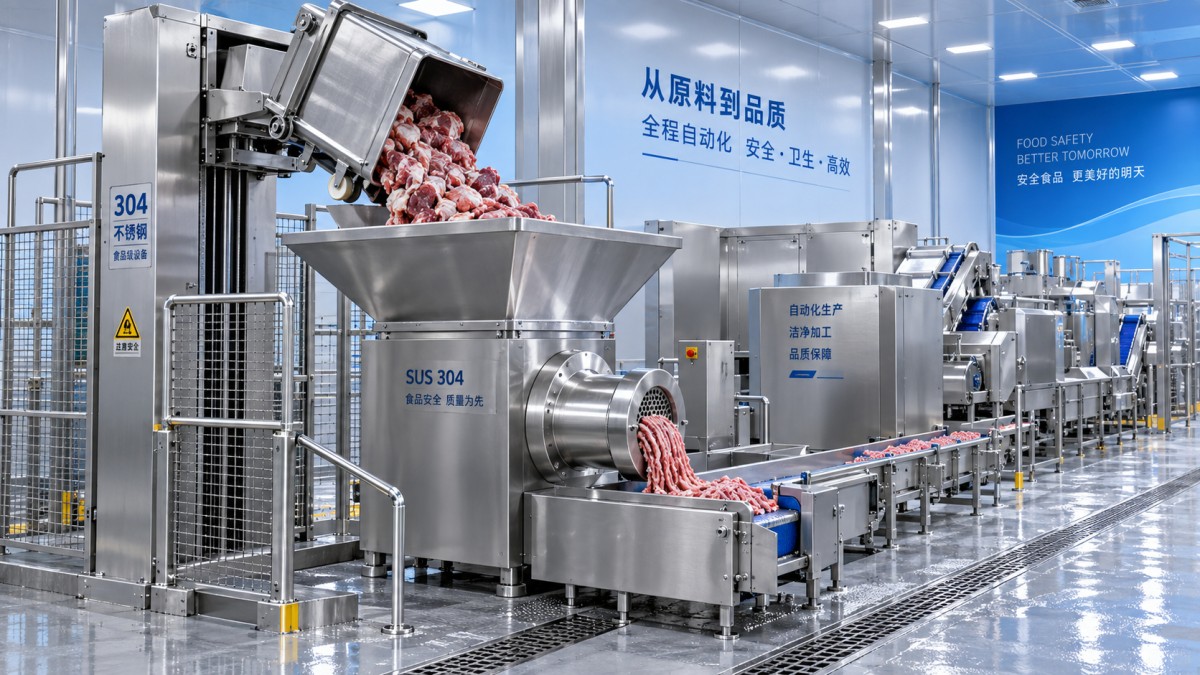
A Meat Elevator delivers return on investment when it removes a repeatable handling constraint rather than merely replacing a few minutes of lifting. The strongest business case appears where meat, fat, trim, or prepared filling must move frequently from low-height bins or carts into grinders, mixers, vacuum tumblers, bowl cutters, sausage stuffers, or other elevated infeed points. In those conditions, manual transfer can limit line continuity, consume paid labor during peak production, and introduce avoidable ergonomic and hygiene exposure.
The decision should not be based on whether an elevator is cheaper than employing one operator. It should be based on the full cost of keeping material movement manual: direct labor, interrupted machine time, product loss, cleaning burden, injury exposure, and the operational limits that prevent the line from meeting its planned output.
Manual handling becomes expensive before it appears expensive
Manual meat transfer often looks economical because the activity is distributed across the shift. One employee loads a trolley, another lifts or scoops product into an infeed hopper, and a third may be called over when a mixer or grinder runs low. The apparent cost is therefore only the wage assigned to the task at a given moment. The real cost is higher when handling creates waiting time upstream or downstream.
Consider a grinder or mixer that must pause while operators refill it. If the machine is technically capable of processing more material than the manual transfer team can deliver, the plant is paying for installed capacity without fully using it. The loss is not limited to lost kilograms per hour. It can affect shift scheduling, order lead times, overtime, cleaning windows, and the ability to absorb demand variation without adding labor.
The point at which a Meat Elevator becomes financially credible is usually marked by one or more of these operating conditions:
- Operators make repeated lifts or transfers throughout the shift rather than occasional batch changes.
- One process regularly waits for raw material, intermediate product, or filling to arrive.
- Production depends on employees performing physically demanding work at hopper height.
- Labor availability forces supervisors to move people away from trimming, portioning, packing, or quality tasks.
- Product transfer involves open handling, spillage, floor contact risk, or difficult-to-clean temporary equipment.
- The plant intends to increase batch size, add a second shift, or introduce a faster downstream machine.
None of these conditions alone guarantees a payback. Together, they indicate that lifting is a production-system issue rather than a minor labor task.
ROI should be measured against the constrained process, not the elevator alone
Capital justification is more reliable when the elevator is evaluated as part of a material-flow path. The key question is: what happens to productive time and operating cost when product moves from the source container to the receiving machine without manual lifting and repeated open transfer?
A practical annual benefit calculation can use the following elements:
Annual benefit = labor redeployment savings + recovered productive capacity value + avoided overtime + reduced handling loss and rework + risk-adjusted safety and sanitation savings − added operating costs.
“Labor redeployment” is more accurate than assumed headcount reduction. In many facilities, an elevator does not immediately eliminate a role; it allows the same personnel to maintain output with fewer interruptions, cover multiple workstations, or avoid adding another operator as volume rises. The financial value is clearest when the business can document a shift in staffing requirement, overtime hours, or throughput per labor hour.
Recovered capacity must also be valued carefully. A faster transfer step has economic value only if another constraint does not absorb the gain. If packaging, chilling, labor at the forming station, or raw-material supply is already the bottleneck, increasing feed speed into a mixer may not increase saleable output. In that case, the elevator may still be justified for safety and hygiene, but its throughput case should not be overstated.
Added operating costs should include electricity, routine inspection, wear items, cleaning time, and maintenance support. These costs are usually manageable in comparison with recurring manual handling, but they should be included in the calculation. Downtime risk should also be considered: a poorly specified elevator that is difficult to wash down, mismatched to bin geometry, or slow to discharge can create a new bottleneck instead of removing one.
Throughput gains depend on transfer rhythm and discharge design
Elevator capacity is not just a catalogue figure. The usable rate depends on load weight, loading frequency, travel height, lift speed, discharge height, tipping angle, product characteristics, and the time needed for the receiving machine to accept the load. Sticky ground meat, chilled trim, fatty material, and prepared fillings do not all behave alike during discharge. A design that empties cleanly with one product may retain material or require operator intervention with another.
Batch-based lines require an especially close look at cycle time. If an elevator carries a bin to a mixer every few minutes, its full cycle includes loading, raising, positioning, discharging, returning, and any cleaning or safety interlock delay. The useful comparison is between this complete cycle and the actual current manual cycle, including walking, waiting, lifting, and cleanup—not an idealized manual transfer time.
For continuous or semi-continuous operations, hopper size and product buffering matter. An elevator can improve continuity only if it delivers enough material to prevent starvation without overfeeding the next machine. The receiving hopper, screw feeder, grinder throat, or stuffing system must be able to accept the transfer rate. Equipment selection therefore starts with a line drawing and measured material-flow data, not simply with the desired lift height.
Hygiene value is often underestimated in the capital request
Manual transfer can add touchpoints, utensils, containers, and exposed handling time. An elevator does not automatically make a process hygienic, but a properly designed system can reduce unnecessary product contact and make the transfer route more controllable. This matters particularly where raw meat moves into a process with defined sanitation controls and tightly managed cleaning schedules.
For food-contact construction, 304 stainless steel is widely used because it provides a durable, cleanable surface for many food-processing applications. Material grade alone, however, is not a hygiene qualification. The more important questions are whether surfaces are accessible for inspection and cleaning, whether joints and welds are finished appropriately, whether product-retaining areas are minimized, and whether the machine can be integrated into the plant’s sanitation procedure without excessive disassembly.
Decision-makers should also verify how the elevator interfaces with existing bins, carts, or standard meat trolleys. A mechanically safe lift that requires manual adjustment, awkward bin alignment, or improvised adapters can undermine both sanitation and labor savings. Compatibility should cover dimensions, lifting points, discharge geometry, locking arrangements, floor space, drainage conditions, and cleaning access.
Safety economics are real, but should not be reduced to a vague claim
Repeated lifting of heavy or unstable loads creates a clear operational concern. Cold, wet surfaces, congested floors, and time pressure can increase the chance of strain, slips, dropped containers, or awkward postures. An elevator can reduce exposure to these tasks, especially where product must be raised above waist or shoulder level. Yet the equipment introduces its own safety requirements: guards, stable load retention, emergency-stop access, safe operating zones, electrical protection appropriate to the washdown environment, and training for normal operation and fault recovery.
The correct comparison is not “manual work is unsafe, automation is safe.” It is whether the proposed design removes the highest-risk motions without creating uncontrolled pinch points, unstable discharge, or unsafe cleaning access. A supplier should be able to explain load limits, safety interlocks, operating sequence, and the conditions under which the lift should not be used.
When the payback case is weak
An elevator may be premature where batches are small, lifts are infrequent, and labor can complete transfers without affecting machine utilization. It may also be a poor fit where the line changes format frequently and bin interfaces are inconsistent. If the operation has no reliable record of current transfer frequency, waiting time, labor allocation, or output loss, the first investment may need to be basic process measurement rather than equipment.
Another weak case occurs when management assumes that automation will solve a broader process imbalance. A lift cannot correct inconsistent raw-material preparation, undersized mixing capacity, inadequate chilling, or poor production planning. It should be selected to resolve a defined transfer constraint with measurable consequences.
That distinction is useful in adjacent food lines as well. A compact Automatic dumpling machine, for example, may reduce forming labor through a one-person operating concept, but its benefit is limited if filling preparation or product supply cannot sustain the forming cycle. The same system-level discipline applies to meat handling equipment: automation creates value when upstream and downstream conditions support it.
A defensible purchase decision starts with a short operating study
Before requesting quotations, record several representative production periods. Measure the number of transfers per shift, average load weight, manual minutes per transfer, waiting time at the receiving machine, number of people involved, overtime associated with the line, and observed cleanup or product-loss issues. Separate normal production from peak-day behavior; the latter often reveals the actual reason an elevator is being considered.
Then define the required duty in operational terms: product type and temperature, container type, maximum load, lift height, required discharge point, target cycle time, cleaning method, available utilities, and floor layout. Quotes that appear comparable on purchase price can differ materially in bin handling, washdown suitability, guarding, controls, installation scope, spare-part support, and commissioning responsibility.
A Meat Elevator earns ROI when it releases a bottleneck that the business can quantify and when its design fits the hygiene, safety, and material-flow realities of the plant. If it only replaces an occasional lift, the capital case may remain marginal. If it stabilizes the feed to a constrained process while reducing repetitive handling and sanitation exposure, its value is better measured in sustained operating capacity than in the price of the machine alone.
Product Center
Leave a message online