
NEWS
Meat Trolley Materials Compared: Stainless Steel Grades, Welds, and Drainage
A Meat Trolley should be specified as a hygienic transport vessel, not treated as a generic stainless container on wheels. The visible steel surface matters, but long-term cleanliness is often decided by less obvious details: the alloy used in wet zones, how seams are closed and finished, whether water can leave the body completely, and whether the frame creates concealed washdown traps. A trolley that looks identical in a quotation can behave very differently after repeated contact with brine, protein residue, detergents, and high-pressure cleaning.
Start with the exposure, then select the stainless grade
Food-grade 304 stainless steel is the practical baseline for most meat handling lines. Its corrosion resistance, cleanable surface, and availability make it suitable for moving fresh meat, trimmed cuts, minced material, and ingredients between preparation, mixing, filling, and packing stages. The material should apply to the product-contact body, rim, discharge area, and any internal reinforcement that could be exposed through damage or drainage openings.
However, the phrase “304 stainless steel” alone is incomplete. A trolley used for short transfers of fresh chilled meat has a different exposure profile from one repeatedly holding salted meat, curing brine, seasoning slurry, or chloride-containing wash water. Chlorides can attack stainless steel locally, especially where moisture remains trapped, oxygen is restricted, or a weld has not been properly cleaned. Brown staining near a seam is sometimes blamed on poor base material when the immediate cause is heat tint, embedded carbon steel particles, or retained cleaning chemicals.
Thickness should not be read as a simple durability score. A heavier sheet resists denting and flexing, yet a poorly supported thick body can still crack at wheel mounts or around a discharge outlet. Conversely, a thinner but well-formed body with adequate folds, stiffeners, and a stable underframe may perform better in normal handling. Ask where reinforcement is placed and whether it creates enclosed cavities that cannot be inspected or drained.
Weld quality determines whether the surface remains cleanable
Welds join the areas most likely to see impact, vibration, and standing moisture. Continuous, properly finished welds are preferable along product-contact seams and at junctions where meat debris could enter. Intermittent stitch welding can leave gaps that are difficult to flush, particularly beneath an upper lip, around a hopper-like corner, or where the internal body meets a support channel.
A smooth weld is not necessarily a sound weld. Excessive grinding can thin the surrounding material, while a polished surface can conceal undercut, pinholes, overlap, or incomplete fusion. Request close photographs or inspect representative samples at the internal corners, lower body seams, wheel brackets, handle connections, and drain fitting. The useful question is whether each joint has a continuous profile without sharp crevices, abrupt ledges, or unsealed overlaps.
Heat discoloration deserves attention. Welding alters the protective surface condition of stainless steel. If heat tint remains heavy, the weld area can lose corrosion resistance before the parent sheet does. Suitable post-weld cleaning and passivation practices restore a more uniform surface condition. They do not compensate for a flawed seam, but they reduce the chance that the weld becomes the first area to stain or pit.
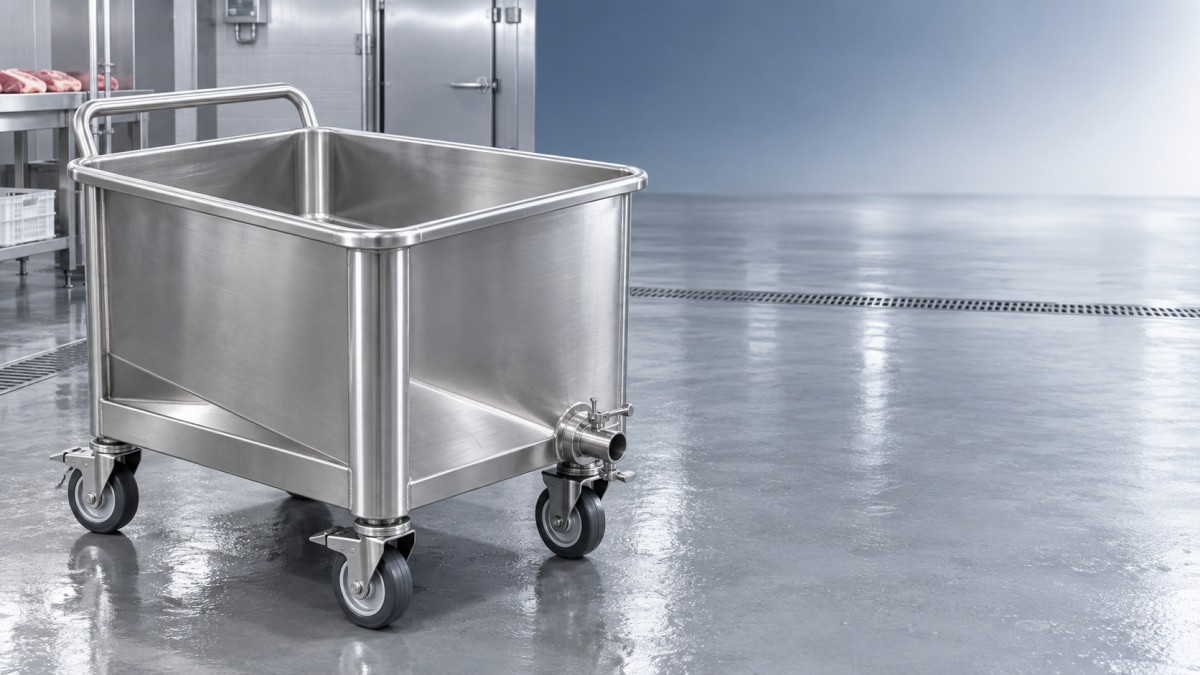
Do not overlook the underside. The lower frame is regularly sprayed but often receives less visual inspection. Open tubular construction is easier to rinse than closed tubing with imperfect end caps. Where hollow sections are unavoidable, fully sealed ends and drainage provisions are necessary; otherwise wash water can enter through a small defect and later leak onto a clean floor or product route. Wheel mounting plates should be smoothly attached, with no narrow slot behind the plate that a wash lance cannot reach.
Drainage is a geometry question
A drain outlet alone does not prove that a Meat Trolley drains. The floor must slope toward it under the trolley’s actual operating orientation. A nominally flat base often develops shallow pools after fabrication, especially if the body flexes under load or the outlet sits above the lowest formed point. These pools retain protein-rich liquid after cleaning and create an avoidable cleaning burden.
Inspect drainage with the trolley parked on the same type of floor used in production. A body that empties on a perfectly level showroom surface may retain water where the plant floor has a slight fall. The discharge route also matters. A small outlet may be adequate for rinse water but block when meat fragments, fat, or seasoning paste reach it. A larger opening drains more freely, but it needs a cap, valve, or screen arrangement that can be removed and cleaned without tools becoming another hygiene trap.
- Floor-to-outlet fall: look for a formed slope rather than relying on a drain installed in a flat panel.
- Lowest-point location: confirm that seams, corner radii, and outlet welds do not create a lower pocket beside the drain.
- Outlet access: the inside, outside, threads, gasket seat, and any valve cavity need direct cleaning access.
- Rim drainage: a rolled or double-wall top edge can hold rinse water unless it is sealed and shaped to shed it.
Drainage design also affects handling. A centrally located outlet underneath the body can be vulnerable when crossing thresholds or positioning over a receiving machine. A side or end discharge may be better protected, but it should not protrude into walking paths or interfere with forks, lift arms, or docking guides. Clearance must be checked with the actual transfer equipment, not only against the trolley drawing.
Match the trolley to the transfer point
Material and hygiene details should be assessed alongside the receiving equipment. When a trolley feeds a mixer, its discharge height, outlet orientation, and wheelbase affect whether transfer is controlled or creates spills around the inlet. This is relevant where minced meat and seasonings move into equipment such as a Meat mixer with a food-grade 304 stainless steel contact zone. A clean trolley is undermined if its outlet cannot align with the next machine without manual scraping or an exposed temporary container.
Casters need the same scrutiny as the body. Stainless forks, sealed bearings suited to washdown, and non-marking wheels are valuable only when the assembly can be cleaned around the axle and brake. Brakes mounted low to the floor collect debris rapidly. A trolley intended for chilled rooms should also roll reliably at operating temperature; wheel tread that becomes hard or brittle changes maneuverability and increases impact loading on welds.
Questions that expose weak specifications
Quotation descriptions often state capacity, overall dimensions, and stainless grade while omitting the details that determine service life. Clarify whether internal seams are continuously welded; whether welds are cleaned after fabrication; whether the body has a true fall to the drain; what material is used for fasteners, caster brackets, and outlet hardware; and how hollow frame sections are sealed or vented. Request a dimensional drawing that includes discharge position, ground clearance, caster layout, and handle projection.
Before release, inspect a finished unit with water rather than judging only from drawings. Fill the body lightly, move it through the intended tilt or discharge position, then rinse it. Remaining pools, weeping joints, inaccessible brackets, and water caught under the rim become visible quickly. That short inspection connects grade selection, weld execution, and drainage performance in the condition that matters: repeated sanitation between meat-processing batches.
Product Center
Leave a message online