
NEWS
Choosing Meat Trolley Volume and Footprint for Batch Processing Lines
Selecting a Meat Trolley begins with batch flow, not catalogue capacity. Technical evaluators should match trolley volume and footprint to the slowest connected process.
The correct specification prevents material queues, excessive manual transfers, sanitation problems, and uneven machine utilization between grinding, mixing, filling, cooking, chilling, or packaging operations.
For most projects, a durable 304 stainless steel trolley is the baseline, but its dimensions, discharge height, mobility, and interface compatibility determine operational value.
Start with the Real Batch Size, Not the Nominal Line Capacity
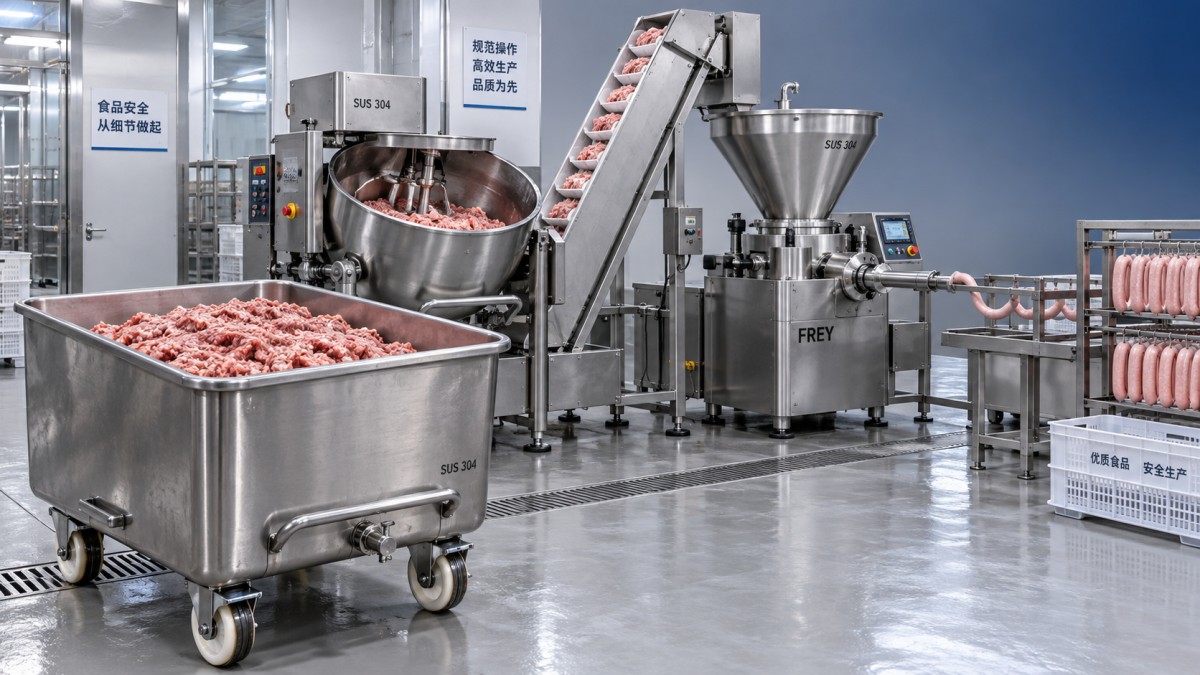
A Meat Trolley should carry a practical batch quantity that supports continuous production without forcing operators to split batches or wait for downstream capacity.
First, identify the usable batch weight from the mixer, grinder, tumbler, or brine preparation stage. This figure is more useful than theoretical hourly output.
For example, a 500 kg mixer batch does not automatically require a 500 kg trolley. Product density, headspace, loading method, and transport safety affect usable volume.
Meat emulsions, coarse-ground products, marinades, and high-moisture formulations behave differently. A trolley must leave adequate freeboard to prevent spills during movement and tipping.
As a rule, evaluate working fill level rather than maximum geometric capacity. A trolley filled to approximately 70 to 85 percent is often easier to handle safely.
Underfilled trolleys create unnecessary trips and labor demand. Overfilled units create overflow risks, difficult cleaning, inconsistent batch control, and avoidable contamination exposure.
Calculate the required number of trolleys from batch size, cycle time, cleaning rotation, and buffer requirements. One trolley per upstream machine is rarely sufficient.
Include holding time in the calculation. If product waits before filling, chilling, or cooking, the trolley fleet must support that buffer without disrupting production flow.
Match Trolley Footprint to the Physical Layout
Footprint is frequently underestimated during equipment selection. A high-capacity Meat Trolley can become inefficient when aisles, turns, doors, lifts, or wash areas are constrained.
Measure the complete travel route instead of only the production room. Include turning radii, drain channels, doorway clearances, ramps, elevator dimensions, and staging locations.
A trolley must also fit safely beneath loading points and align correctly with discharge equipment. Misalignment increases handling time and raises product loss risks.
Technical evaluators should map every transfer point between receiving, grinding, mixing, stuffing, thermal processing, and packaging. Each transfer reveals a potential footprint limitation.
Consider whether workers can pass alongside parked trolleys without blocking emergency access or sanitation routes. Floor plans must account for both motion and temporary accumulation.
In compact plants, slightly smaller units may provide better overall throughput than larger units. Faster movement and cleaner staging can outweigh the benefit of fewer transport cycles.
Where automated lifters are used, verify trolley base dimensions, wheel positions, engagement points, and center of gravity. A nominal volume match alone is insufficient.
Check the Interface Between the Trolley and Filling Equipment
Batch processing lines perform best when the trolley becomes a predictable buffer between mixing and filling. The connection must protect product quality and operator safety.
Confirm whether the filler accepts direct loading, mechanical lifting, vacuum transfer, or manual feeding. Each method creates different requirements for trolley height and geometry.
For high-output sausage operations, a trolley should support repeatable loading into the filler hopper with minimal exposure time. Smooth transfer protects temperature control and formulation consistency.
A Sausage Filler with a 220 L hopper and optional lifter configuration may require trolley dimensions that allow stable, accurate lifting alignment.
When evaluating GZY3000 or GZY6000 filling systems, compare trolley batch quantity with filling capacity. A 3,600 kg/h or 6,000 kg/h rate can empty buffers quickly.
Filler performance also affects trolley circulation. If stuffing reaches up to 500 portions per minute, operators need sufficient prepared material without crowding the processing area.
Confirm that the trolley supports hygienic transfer into vacuum filling systems. Reduced oxygen exposure helps limit oxidation, protect color, and improve finished-product shelf life.
Balance Volume Against Product Handling and Ergonomics
Larger capacity is not always safer or more economical. The loaded trolley weight must remain manageable for the plant’s transport method, floor condition, and operator capability.
Assess how the trolley will move during normal production. Push handling, pallet transport, rail systems, electric movers, and hydraulic lifters impose different loading limits.
Wheel selection matters as much as container volume. Wheels should roll reliably over wet floors, drains, thresholds, and cleaning zones without introducing unstable movement.
Evaluate the effort required to start, stop, and turn a fully loaded trolley. Poor maneuverability can increase injury risk and create delayed batch handovers.
The trolley’s center of gravity becomes critical during lifting and tipping. Tall, narrow units can save floor space but require careful engineering and secure lifting compatibility.
For manually loaded operations, consider loading height and access. Operators should not need to overreach into deep containers or repeatedly lift heavy meat blocks above shoulder level.
Ergonomic design should be assessed with actual product weight, not empty trolley weight. A lightweight trolley can still be unsuitable when filled with dense meat mixtures.
Specify Hygienic Construction for Daily Production Reality
Material handling equipment is part of the food-contact environment. The trolley must withstand repeated washing, chemical exposure, cold conditions, and daily physical impacts.
SUS304 or 304 stainless steel is widely preferred because it provides corrosion resistance, durability, and a smooth hygienic surface suitable for meat processing applications.
Inspect weld quality, internal corners, drainage behavior, and surface finishing. Rough areas, incomplete welds, and standing-water points can make cleaning slower and less reliable.
Rounded internal transitions simplify removal of meat residue. A design that appears clean externally may still create sanitation concerns when seams and undersides are difficult to access.
Check whether the trolley drains completely after washing. Residual water can dilute product, increase microbial risk, and delay release of equipment back into production.
Technical teams should define cleaning validation requirements before purchase. This includes washdown pressure, detergent compatibility, drying time, visual inspection access, and maintenance procedures.
Also consider component replacement. Wheels, bearings, seals, and lifting interfaces should be serviceable without extended downtime or difficult disassembly in hygienic areas.
Use Throughput Calculations to Avoid Hidden Bottlenecks
Throughput planning should connect trolley volume with actual machine cycle times. The goal is to maintain steady flow while preserving enough buffer for normal variation.
Start by dividing the required hourly output by expected usable trolley load. Then compare the resulting trips per hour with travel, loading, unloading, and cleaning time.
If a line produces 3,000 kg per hour and each trolley carries 400 kg of usable product, the system requires at least eight completed movements hourly.
That calculation must include contingency. Equipment changeovers, formulation changes, operator breaks, washdown, minor stoppages, and quality holds can rapidly consume available trolley capacity.
For automated filling lines, synchronize trolley replenishment with filler demand. A poorly timed refill can idle expensive equipment even when total material capacity appears adequate.
Assess peak demand rather than average demand. Short production surges often reveal whether trolley volume and fleet size can maintain output without unsafe staging practices.
Document assumptions in the equipment specification. This allows suppliers to recommend compatible trolley dimensions, lifter systems, filler interfaces, and material-handling alternatives with fewer revisions.
Build a Practical Selection Checklist
A defensible trolley decision combines capacity, footprint, hygiene, ergonomics, and equipment compatibility. Reviewing these factors together reduces the risk of isolated purchasing decisions.
Record the target usable batch weight, product density, maximum fill level, expected trips per hour, travel route dimensions, loading approach, and cleaning procedure.
Then verify compatibility with mixers, grinders, vacuum systems, lifters, and filling equipment. Confirm dimensions physically whenever possible instead of relying only on drawings.
Finally, test the proposed configuration under representative operating conditions. A short handling trial can expose clearance, tipping, drainage, and labor issues before installation.
The right Meat Trolley is a production-control asset, not simply a container. Correct volume and footprint choices support safer handling, cleaner operations, stable throughput, and reliable batch processing.
Product Center
Leave a message online