
NEWS
Cleaning Meat Trolleys to Reduce Cross-Contamination Between Product Runs
Cleaning Meat Trolleys to Reduce Cross-Contamination Between Product Runs
In meat processing, a properly cleaned Meat Trolley is not just a housekeeping detail. It is a direct control point between one product run and the next. A trolley that carries trim in the morning, seasoned product at midday, and a different protein or allergen-containing formulation later in the shift can transfer residues far more easily than people expect. Meat particles lodge beneath rails, around wheel brackets, inside weld seams, and under removable bins. Moisture then gives surviving microorganisms a route to spread.
The difficult part is that a trolley may look clean from the aisle while still holding contamination in areas that are rarely inspected. Quality and food safety teams need a cleaning process that is practical on the floor, repeatable during changeovers, and strict enough to address the real risk points—not merely the visible ones.
Why Product Changeovers Create a Trolley Risk
Cross-contamination is often discussed in terms of slicers, grinders, conveyors, and filling equipment. Yet mobile transport equipment can be an overlooked link in the chain. A Meat Trolley moves between processing rooms, chillers, staging areas, and wash zones. Its casters can pass through wet floors, its handles are touched repeatedly, and its interior surfaces may contact raw meat, cooked product, marinades, or rework materials.
The risk rises when the next production run has a different microbiological, allergen, or quality profile. For example, moving from a seasoned sausage batch to an unseasoned product may create an ingredient carryover concern even if there is no visible food residue. Similarly, a trolley used in a raw area should not be assumed safe for post-cook handling simply because it has been rinsed.
The key distinction is between cleaning and sanitizing. Cleaning removes soil, fat, protein, and debris. Sanitizing is intended to reduce microorganisms on an already clean surface. If fat film or protein residue remains, sanitizer may not contact the stainless steel effectively. This is why a quick spray-and-go routine often fails during busy shifts.
Start with a Trolley That Can Actually Be Cleaned
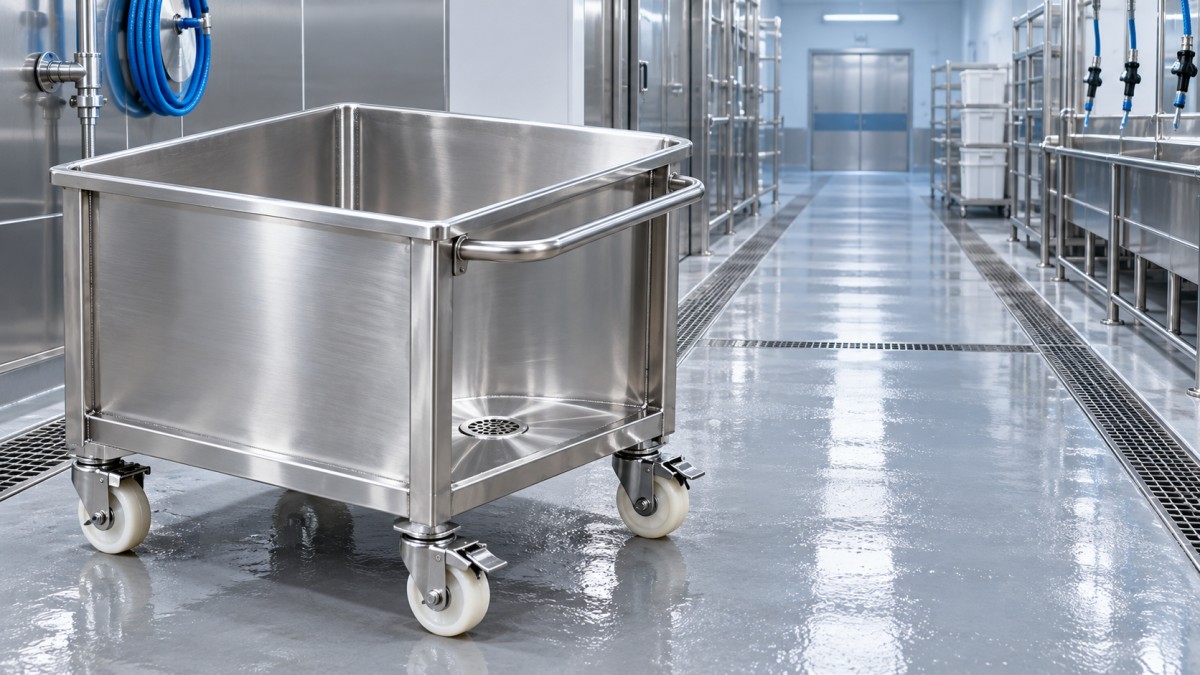
Cleaning performance begins with equipment design. Food-contact trolleys made from 304 stainless steel are commonly selected because the material is durable, corrosion-resistant in normal food plant use, and better suited to repeated washing than painted or porous alternatives. But stainless steel alone does not solve a hygiene problem. Poorly finished welds, inaccessible underside structures, damaged wheels, and cracked seals can still retain soil.
Before revising sanitation instructions, walk the trolley with the cleaning crew rather than reviewing it only from a drawing. Ask them where water pools, which parts cannot be reached with a brush, and where product catches during unloading. Their answers usually reveal the areas that deserve extra attention: drain corners, rim folds, handle joints, wheel axles, push bars, and the lower frame.
A useful rule is simple: if an operator cannot inspect a surface after cleaning, the sanitation program should not assume that surface is clean. In some plants, removable wheels or easily accessible caster assemblies are worth the additional maintenance effort because they make verification more realistic.
A Practical Cleaning Sequence Between Runs
The exact chemical concentration, water temperature, contact time, and verification method should follow the site’s approved sanitation program and chemical supplier instructions. Still, the physical sequence matters in nearly every operation.
- Remove gross debris first. Empty the trolley completely and scrape or collect meat residues before applying water. Sending large particles into drains does not count as cleaning and can create additional sanitation problems nearby.
- Pre-rinse with control. Use enough water to loosen soil, but avoid high-pressure practices that aerosolize residues onto surrounding equipment, walls, or personnel. Start from cleaner upper surfaces and work toward lower, dirtier components.
- Apply detergent and provide mechanical action. Detergent needs time to break down protein and fat, but time alone is rarely enough. Brush seams, handles, corners, discharge areas, and caster brackets with dedicated tools. A brush that never reaches the wheels is not a complete trolley-cleaning tool.
- Rinse until no soil or foam remains. Inspect under good lighting. Residual foam can hide remaining grease, while leftover detergent may interfere with the next sanitation step.
- Sanitize and allow the required contact time. Do not wipe off a sanitizer prematurely unless the chemical instructions specifically require it. Pay attention to handles and wheel assemblies, since these are high-touch and high-exposure zones.
- Drain, dry where feasible, and protect the clean trolley. A sanitized trolley parked in a splash zone or pushed through a raw corridor can be recontaminated before it returns to service.
One operational mistake is treating every changeover as identical. A same-product continuation may need a different level of intervention than a switch involving allergens, raw-to-cooked segregation, or a product with a different seasoning profile. The decision should come from the plant’s risk assessment, not from how much time is available before the next batch.
The Wheel Area Deserves More Attention Than It Usually Gets
Casters are frequently the weakest point in trolley sanitation. They collect meat debris, fat, floor water, and residues from drains or traffic lanes. Then they carry that contamination to another area. Even when wheels do not directly touch product, they can contaminate floors and create indirect transfer through footwear, hoses, pallets, or splashing water.
For facilities with distinct hygiene zones, color coding, dedicated trolley fleets, or controlled trolley transfer points may be more reliable than relying on cleaning alone. Where equipment must cross zones, the sanitation procedure should explicitly include wheel cleaning and a decision on whether the trolley may enter the next area. “Cleaned” and “approved for high-care use” are not always the same status.
Verification Should Look Beyond a Visual Check
Visual inspection is necessary, but it is the first check, not the final proof. A supervisor should inspect the places most likely to be missed rather than only the broad interior surface. Use a flashlight if needed. Check underside rails, wheel guards, drain points, handles, and weld transitions. If a trolley is difficult to inspect while standing upright, build that limitation into the cleaning method instead of accepting it as normal.
Many plants also use their established hygiene verification tools, which may include ATP monitoring, protein residue checks, allergen-specific testing where relevant, or microbiological environmental sampling. Each method has limits. ATP can indicate remaining organic material but does not identify a specific pathogen or allergen. Swab results must be interpreted within the site’s own sampling plan. The important point is consistency: sample meaningful locations, trend recurring failures, and respond to patterns rather than treating every failed check as an isolated cleaning error.
If the same trolley repeatedly fails inspection near a wheel housing or a damaged weld, retraining alone may not fix the issue. It may be an equipment-design or maintenance problem. Bent frames, pitted surfaces, loose caster seals, and cracked plastic components should be repaired or replaced before they become permanent harborage points.
Keep Cleaning Tools, Traffic, and Equipment Planning Connected
A good trolley sanitation routine can be undermined by the tools used to perform it. Brushes, foaming equipment, hoses, and squeegees need their own storage and cleaning controls. Using the same brush for floor drains and food-contact trolley interiors is an obvious problem, but more subtle mix-ups happen when tools are left on carts or hung without zone identification.
Equipment planning matters across a broader processing line as well. Manufacturers supplying meat, sausage, and pasta processing equipment often need to consider how transport items, washdown access, and material selection affect daily sanitation—not just production capacity. The same principle applies in pasta areas: equipment such as a Dough Mixer may use vacuum mixing to remove air from flour particles and develop a smoother, more elastic dough, but it still needs cleaning access appropriate to its ingredients and operating environment. Different products, same basic lesson: hygiene is easier when cleanability is designed in from the start.
For meat operations, the most dependable approach is to define trolley ownership, travel routes, cleaning triggers, inspection points, and release responsibility in one workable procedure. A Meat Trolley should return to production only when it is visibly clean, properly sanitized according to the site program, protected from recontamination, and suitable for the specific product run ahead. That discipline is less glamorous than installing a new machine, but it is often where cross-contamination control is won or lost.
Product Center
Leave a message online