
NEWS
Meat Trolley Workflow Design for Cutting, Mixing, and Filling Areas
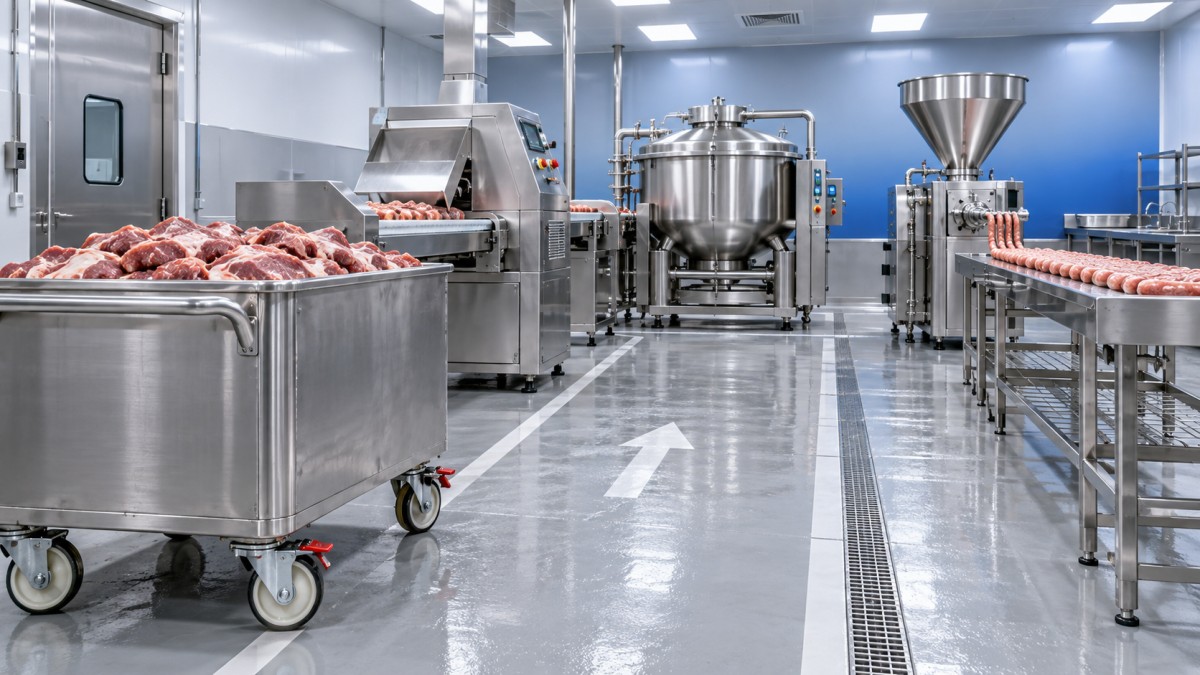
A Meat Trolley workflow should be designed as a controlled transfer system between cutting, mixing, and filling, not as a convenient movable container. In sausage and formed-meat production, a poorly planned trolley route can create avoidable handling, congestion around machines, delays while batches wait, and sanitation exposure at the point where raw material becomes finished filling.
For technical evaluators, the practical question is whether the trolley supports the production sequence without becoming a hygiene or throughput bottleneck. The best layout depends on batch size, product temperature requirements, floor space, cleaning routines, and the discharge and loading heights of the connected equipment. A larger trolley is not automatically more efficient if it cannot be positioned safely under a grinder, moved through the aisle, or emptied cleanly into the next machine.
Start with material direction, not trolley quantity
The basic route should move in one direction: cutting or grinding, then mixing, then filling. Trolleys should not routinely travel back through cleaner areas after receiving raw meat, seasoning residues, or trim. Where the same trolley fleet must serve several stages, the layout needs an explicit return route and a defined wash or release point before equipment is reused.
This sounds straightforward, but many layouts fail because trolleys are added after the main machines are positioned. The result is often a blocked operator zone: a trolley waits at the mixer discharge, another stands beside the filler, and staff must steer loaded containers around controls, drains, hoses, and personnel. The process may still run, but operators spend time repositioning material rather than producing it.
Before selecting trolley sizes, map each batch movement on the floor plan:
- Where the trolley is loaded and whether loading occurs from a cutting table, grinder discharge, or manual transfer point.
- Whether it must pass through doors, chilled rooms, wash areas, or narrow turns.
- Where it waits before mixing and how long the product may remain there.
- How it aligns with mixer loading and discharge points.
- Whether the filling machine accepts direct trolley feeding, a hoist, a vacuum transfer arrangement, or a separate loading device.
- How empty trolleys return without crossing the active raw-material route.
A layout with short travel distance is useful, but direction and access matter more than pure distance. A slightly longer route that keeps loaded trolleys out of the filling operator's space is often easier to clean, supervise, and operate consistently.
Match trolley capacity to batch logic
Capacity should be chosen around the smallest meaningful production batch and the actual charge size of the downstream mixer. If one mixing batch requires several full trolleys plus a partial trolley, staff must repeatedly estimate residual quantities and manage extra transfers. That complicates recipe control and raises the chance of a batch being mixed out of sequence.
Conversely, using an oversized trolley for small or variable batches can create handling problems. A partially filled trolley may be harder to move predictably, and deep container geometry can make manual inspection, cleaning, or complete discharge more difficult. Capacity decisions should therefore consider usable volume, product density, maximum permitted load, and the ability to empty the container without leaving material trapped in corners or below the outlet level.
For a line built around vacuum mixing, the trolley plan should also reflect the mixer’s batch range. A mixer family offered from 50 L through 1,200 L allows different line scales, but its nominal chamber volume should not be treated as the material quantity that a trolley must always carry. Formulation, meat cut, ice or liquid addition, vacuum process requirements, and loading clearance all affect the working fill level. Technical teams should define a repeatable batch mass first, then specify the number and capacity of trolleys needed to supply it.
Consider the handoff at the mixer
The transfer into and out of the mixer is where trolley design becomes an equipment-integration issue. Check loading height, lifting method, required tipping angle, clearance around guards, and whether a loaded trolley can be staged without restricting access to the controls or cleaning area. A trolley may fit physically beside a machine but still be unsuitable if the operator must reach around it to connect vacuum lines, inspect the product, or initiate discharge.
For example, a vacuum mixer that is intended to connect with grinders, choppers, and filling machines should be evaluated with the full transfer path in view. The Vacunum Meat Mixer uses variable-frequency speed regulation and forward/reverse mixing control, with low temperature rise during operation. Those processing features are meaningful only when the trolley workflow delivers the prepared meat promptly and provides a clean, practical path for mixed filling to reach the next stage. Long waiting periods in an uncontrolled staging location can undermine the operational benefit of a well-matched mixer.
Design for sanitation at movement points
304 stainless steel is generally the preferred construction for food-contact trolley bodies because it is durable and suitable for routine washdown when fabrication details are appropriate. However, material grade alone does not determine sanitary performance. Open seams, poorly finished welds, inaccessible wheel brackets, hollow members without proper sealing, damaged casters, and difficult-to-reach underside surfaces can turn a durable trolley into a cleaning burden.
The trolley should be assessed as a complete cleanability system. Inspect the interior corners, rim profile, drainability after washing, wheel and axle access, handle geometry, and the relationship between the trolley base and the floor. A design that appears simple in a product image may still retain water or debris around structural joints. This is especially important where trolleys circulate between raw meat preparation and post-mixing filling operations.
Segregation should be operationally visible. Facilities may use designated parking bays, route markings, physical separation, or clearly controlled cleaning release procedures. The specific method depends on the plant’s hygiene zoning, but relying on staff memory alone is weak control when several trolley sizes or production recipes run during the same shift.
Wheel selection affects both hygiene and throughput
Casters are often treated as a minor specification, yet they determine how readily an operator can move a loaded Meat Trolley through a real processing room. Floor joints, wet areas, drain channels, door thresholds, and changes in surface condition all affect rolling resistance. Wheels that perform adequately on a smooth showroom floor can become difficult to steer once exposed to water, protein residue, cleaning chemicals, and routine impacts.
Technical evaluation should cover wheel diameter, load rating, bearing protection, brake function, swivel behavior, and access for inspection. The trolley must track reliably during movement and remain stable when parked at loading or discharge stations. Brakes are particularly relevant where material is loaded manually, where the trolley is positioned under a lift, or where floors have even a slight gradient.
There is also a layout implication: tight turns encourage side-loading of casters and frequent collisions with equipment legs or walls. If the route requires repeated sharp turns, modifying the aisle or changing the trolley footprint may deliver more value than specifying a heavier trolley. A maneuverable container cannot compensate for a route with insufficient clearance.
Separate staging from storage
Trolleys are useful for short process staging, but they should not become undefined storage points. When batches accumulate between cutting and mixing, the production team loses a clear view of sequence, dwell time, and ownership. At the filling end, too many mixed batches queued in trolleys can leave operators choosing the next container based on convenience rather than the intended production order.
Define limited staging positions at each handoff. Each position should have a purpose: waiting for mixer loading, waiting for discharge transfer, or awaiting cleaning. Keep empty clean trolleys separate from emptied trolleys that have just received product. This simple distinction reduces unnecessary travel and makes it easier to identify whether the constraint is cutting capacity, mixing cycle time, filling speed, or inadequate trolley availability.
For central kitchens and smaller meat plants, one trolley may serve multiple roles because floor space and equipment count are limited. In that case, the workflow needs more discipline rather than more assumptions: a fixed cleaning trigger, a clear sequence for batch release, and enough turnaround time to avoid using a trolley before it is ready. For higher-output lines, dedicated trolley pools for raw preparation and mixed filling can reduce conflict between operations.
A practical evaluation sequence
Assess the proposed workflow with representative batch weights, not empty containers. Walk the route from cutting to filling and observe every point where a trolley must stop, turn, wait, be lifted, or be cleaned. Confirm that the selected unit fits the production batch, interfaces with the mixer and filler, remains stable under load, and can be fully washed without difficult-to-access residue points.
The strongest trolley workflow is usually the one with the fewest ambiguous handoffs. Material moves forward, operators have room to work, cleaning status is clear, and the container capacity supports the actual mixing and filling rhythm. Once those conditions are established, trolley quantity and detailed features can be specified with far less risk of building inefficiency into the line.
Product Center
Leave a message online