
NEWS
Meat Trolley Lifetime Cost: When Premium Casters and Welds Pay Off
A lower-priced trolley can be the economical choice for light, dry-duty handling. In a busy meat plant, however, the purchase price often becomes a minor part of the decision. Frequent washdown, heavy batches, thresholds, turns around processing equipment, chilled rooms, and repeated loading all concentrate wear on the same points: casters, welds, frame joints, and corrosion-prone surfaces.
Premium casters and stronger weld construction pay off when a trolley is a production-critical asset rather than occasional storage equipment. The question for a business evaluator is not whether the trolley looks more substantial on delivery. It is whether its higher specification avoids enough labor disruption, maintenance, hygiene exposure, and early replacement to justify the difference over its working life.
Start with the duty cycle, not the catalogue price
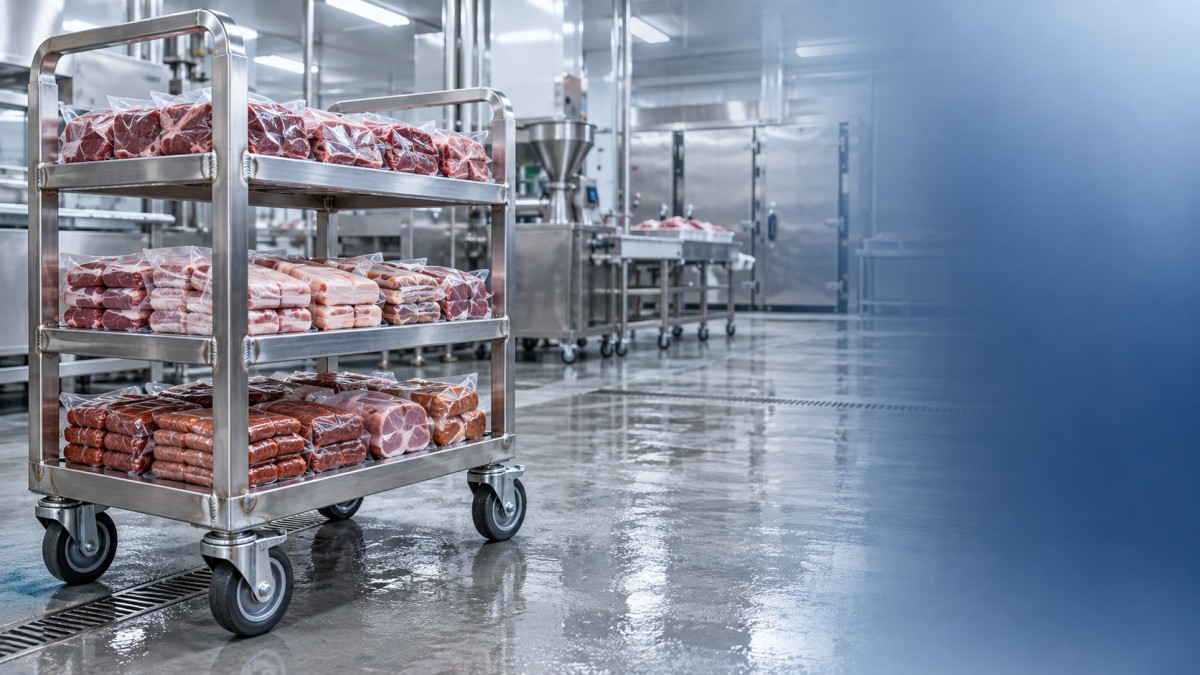
Two Meat Trolley units with similar capacity and dimensions can have sharply different lifetime costs because their operating conditions are different. A trolley moving packaged product across a smooth warehouse floor faces a relatively gentle duty cycle. A trolley carrying meat ingredients or filled products between preparation, filling, clipping, cooking, chilling, and packing areas is exposed to higher loads, moisture, cleaning chemicals, and more frequent movement.
Before comparing quotations, map the trolley's actual route. The most useful questions are practical ones:
- How many loaded trips will it make in a shift?
- What is the typical load, and are peak loads materially higher?
- Will operators push it over drains, door sills, uneven floors, ramps, or dock plates?
- Is it washed down routinely, and with what cleaning method?
- Does it enter chilled, wet, or high-salt processing areas?
- Would a failed trolley interrupt a line, create a manual-handling problem, or force product to wait?
A low-utilization trolley may not warrant an upgraded caster package or extensive reinforcement. Conversely, a trolley used continuously in wet production can become expensive very quickly when wheels bind, bearings fail, welds crack, or a frame becomes difficult to clean. The same specification should not be applied across every department simply for purchasing convenience.
Casters are often the first lifetime-cost decision
Casters are consumable components, but treating them as interchangeable is a common procurement error. Wheel material, bearing protection, fork strength, swivel construction, axle design, and mounting method all affect how long the trolley remains usable under load.
Cheaper casters may perform acceptably on flat, clean floors with modest loads. Their limitations usually appear under side loads, repeated impact, washdown, or poor floor transitions. A seized swivel can make a trolley difficult to steer. A damaged wheel can increase operator force and transmit shock into the frame. Loose caster mounting hardware can accelerate fatigue around the base of the trolley.
The cost is not limited to a replacement wheel. Someone must identify the issue, remove the trolley from use, source the correct component, fit it, and verify that the trolley is stable and safe. If the unit is needed to keep material moving, the plant may also absorb delays or use a less suitable substitute. Those indirect costs are why a better caster assembly is often justified for high-frequency routes.
For evaluation purposes, ask suppliers to specify the caster construction rather than simply listing a wheel diameter. Confirm the rated load per caster in the intended configuration, bearing type, corrosion resistance, wheel tread material, temperature suitability, and availability of replacements. A caster that is technically load-rated but difficult to replace locally can still create an operational problem.
Floor condition deserves equal attention. Premium casters cannot correct broken floors, aggressive drain edges, or poorly designed thresholds. If the trolley route repeatedly generates impacts, correcting the route may offer a better return than buying a stronger wheel alone. The best result normally comes from matching wheel selection, load limits, and floor maintenance.
Weld quality matters when fatigue, hygiene, and repair risk meet
Welds are easy to overlook because they are not a moving part. Yet they determine whether the trolley can withstand repeated torsion and impact over time. The critical issue is not simply that welds exist at corners. It is whether load-bearing connections are consistently formed, accessible for inspection, and supported by a frame design that does not concentrate stress in a small area.
Weak or incomplete welds may remain unnoticed when a trolley is new. Repeated loading, sharp turns, curb-like impacts, and forceful pushing can reveal fatigue later, particularly around caster plates, handles, shelves, and vertical-to-horizontal frame connections. A repaired trolley may return to service, but repair welding can create downtime and is not always desirable in a hygiene-sensitive environment if the result leaves rough, hard-to-clean surfaces.
For meat processing, cleanability is part of the weld decision. Smooth, continuous fabrication where it is needed reduces places where residues and moisture can collect. Excessive crevices, rough spatter, open tube ends, and inaccessible joints make cleaning more difficult and complicate visual inspection. A trolley built from 304 stainless steel provides a solid baseline for many food-processing applications, but material grade alone does not compensate for poor fabrication details or an unsuitable cleaning regime.
Evaluators should inspect a sample unit or detailed fabrication images with several specific points in mind: the caster mounting area, lower frame corners, handle joints, internal corners, drainage provisions, tube closures, and the finish around welds. This is more revealing than judging the trolley by polished surface appearance alone.
Calculate cost through availability, not just replacement price
A useful comparison does not require speculative industry averages. Build a simple internal model using the conditions of the facility. Include the initial purchase cost, expected preventive maintenance, likely replacement components, internal labor for repairs, cleaning burden, and the cost of having an asset unavailable when it is needed.
The comparison becomes clearer when the trolley fleet is considered as an operating system. A plant with many identical units may gain value from standardized caster spares and a clear inspection routine. A small operation with only a few trolleys may need a more robust specification because there is little redundancy when one is removed from service.
Premium construction is therefore most likely to pay off where downtime is costly, handling is repetitive, and conditions accelerate wear. It is less compelling where the trolley sees light movement, carries modest loads, remains in a dry environment, and can be replaced without interrupting production.
Line integration can change the priority
Material handling equipment is often evaluated separately from processing machinery, even though its reliability affects the rhythm of the line. In sausage production, for example, a trolley may supply materials, collect output, or move product between filling and downstream operations. If a clipping station runs at a pace that depends on consistent material flow, unstable handling equipment can create avoidable pauses around an otherwise reliable machine.
A line built around a Sausage Clipper with adjustable output speed and automatic casing cutting should be assessed as a connected workflow. The trolley does not need to match the machine's technical complexity, but it must support the required throughput, fit the available aisle and transfer space, and remain controllable when loaded. Buying a heavy-duty trolley that is too wide for the route or too tall for a transfer point can erase the benefit of stronger components.
When paying more is justified
A higher-specification Meat Trolley is usually defensible when several conditions occur together: daily loaded use, wet or chemically cleaned areas, heavy or uneven loads, imperfect floors, limited spare equipment, and a meaningful consequence when material cannot move. Under those conditions, protected bearings, durable wheel assemblies, reinforced caster zones, well-finished welds, and food-appropriate stainless construction are operating-cost controls rather than cosmetic upgrades.
Where the duty cycle is mild, a simpler trolley can be the better commercial choice. The disciplined approach is to avoid buying either the cheapest frame or the most elaborate specification by default. Define the route, load, sanitation exposure, repair capability, and downtime consequence first. Once those conditions are visible, the point at which premium casters and welds pay for themselves is usually much easier to defend in a procurement decision.
Product Center
Leave a message online